From Our Archives
For earlier essays on this week's RCL texts, see Dan Clendenin, Everything in Excess (2023); Debie Thomas, On Fairness (2020); and A Troubling Generosity (2017).
This Week's Essay
By Amy Frykholm, who writes the lectionary essay every week for JWJ.
Psalm 105:3: “Let the hearts of those who seek the Lord rejoice."
For Sunday September 20, 2026
Lectionary Readings (Revised Common Lectionary, Year A)
Psalm 105:1–6, 37–45 or Psalm 145:1–8
Philippians 1:21–30
Matthew 20:1–16
I can still hear Judy yelling my name from the entrance of the church. “AIMMMMMEEEEEEE,” she would call, a screech at top volume. “Your angel is here!” My first response — always inside myself — was to be annoyed, to brace myself for her enormous hug, her loud voice, her immense presence, as if against a strong wind. But then I would go out of the kitchen and submit to her warmth, her enthusiasm, and her care for me.
One day she called me to let me know that the coming Friday was her sister’s birthday, and she wanted to celebrate. Her sister had died some years before, but Judy appreciated any occasion to celebrate, and even though they had been estranged when her sister was alive, she loved remembering her.
“How do you want to celebrate?” I asked, and then instantly regretted it. I knew there would not be a simple answer and whatever she said, I would feel obligated to it.
“Hamburgers and French fries,” she said. Upon reflection, after many years of remembering these events, I realize I could have purchased her a gift certificate to a local restaurant. No one was forcing me to interpret this as a cooking assignment. But I did. On Friday, at the community meal, I was going to make hamburgers and French fries for Judy and her dead sister and everyone else who came to the meal that day.
But there are certain rules I have for myself about cooking these meals. I keep to a rigorous program of using only what we have or what has been donated. I almost never shop for a meal. I love the power of instant invention, making food out of whatever I find. It feeds me creatively and is, I find, more fun than planning.
 |
|
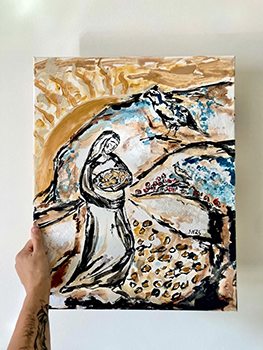
Sarah Norton, The Bread Come Down: Manna and Quail.
|
So even on this day, when I had a specific assignment, I showed up as usual at the meal hoping for the best. The first miracle was that there was a pan of already cooked potatoes in the refrigerator. I could crisp those up and they would be a close enough approximation to French fries that I felt, with some ketchup, they might satisfy Judy’s craving.
The second miracle was that there was indeed ground beef in the freezer, so I could make at least some hamburgers.
But there were no hamburger buns. I should send someone to the store, I thought. But no one with a car arrived. I could use ordinary bread. But would Judy be disappointed? I worried. Now, as I am writing this, I am laughing at myself. I remember a friend asking me in a different context, “What would this look like if it were easy?” I am observing how I stubbornly insisted on the hardest possible path.
But never mind. We had no hamburger buns. Maybe some would arrive with the first delivery from the local grocery store, where we received day-old bread. But the delivery came and went without hamburger buns. Then the next grocery store delivery arrived—this one from out of town. No hamburger buns in that one either. We were out of luck.
I was thinking about how I might cut ordinary bread into the shape of a bun, for Judy’s hamburger anyway, when a car pulled up in front of the church. A woman came in with two grocery bags in either hand. “Hi. I was told to bring these bags over here,” she said. “I don’t know what’s in them.” She handed them to me. I could tell almost immediately that there were hamburger buns inside.
 |
|
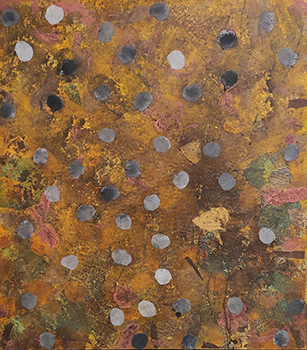
Terri Davis, Manna 3.
|
Judy had her French fries and hamburger — on a proper hamburger bun — and I had a good laugh: at myself, and at the strange provision that had arrived. I’ve looked back on this event many times, and I have far more questions about it than I have answers. All I really know is that some mysterious force of provision wanted Judy to have her hamburger and French fries, and she did.
The question that the Israelites ask when the manna arrives is, “What is it?” (Exodus 16:15). I feel like I’ve been asking this question about Judy’s hamburger buns for years now. In my case, it’s not about the actual substance so much as the way in which it was provided. The Israelites are in the wilderness, learning day by day what it means to be God’s people. They complain about food. How are they supposed to get their needs met in this desert? Hunger is not funny, but something about the way this story is told makes me laugh. Their complaints are recognizable, all too human. “If only we had died by the hand of the Lord in the land of Egypt,” they tell Moses, “when we sat by the pots of meat and ate our fill of bread” (16:3). Hunger and fear have caused them to romanticize even their own slavery. This feels a bit like me saying, “How could You have provided hamburgers and French fries, but no buns?”
But the Israelites, nonetheless, wake up one morning, after the evening’s miraculous provision of quail, to find “a layer of dew around the camp. When the dew lifted, there on the surface of the wilderness was a fine flaky substance, as fine as frost on the ground” (16:13-14).
“What is it?” they ask. “It is the bread that the Lord has given you to eat,” Moses replies (16:15).
 |
|
Aleksandr Konovalov, Manna from Heaven (2022).
|
Manna is both a question (what is it?) and an answer to a question (it is bread). It is nourishment and provision when such things feel impossible, but it is also the establishment of a relationship, even a conversation.
Every need that arises, throughout our lives, no matter how trivial, is an opportunity to have this conversation. We don’t have to ask nicely, without complaining. We don’t have to do it right. We’re invited to participate, even with our foibles and our grievances, our certainty that our needs won’t be met. At the same time, our relationship with God in the wilderness of our lives is not a vending machine. We don’t stick money in and get what we want. It’s an interaction, a dynamic, an opportunity to grow.
At my church, we’ve started to refer jokingly to this dynamic, which we’ve seen play out over and over again, as “St. George magic,” as if the building itself were playing some part in the practice of surprising provision. But we don’t really know how it works. We are, however, ever so gradually, like the Israelites in the wilderness, learning to trust it.
Weekly Prayer
Lynn Ungar
Blessing the Bread
Baruch atah Adonai, Eloheinu melech ha'olam,
hamotzi lechem min ha'aretz.
Surely the earth
is heavy with this rhythm,
the stretch and pull of bread,
the folding in and folding in
across the palms, as if
the lines of my hands could chart
a map across the dough,
mold flour and water into
the crosshatchings of my life.I do not believe in palmistry,
but I study my hands for promises
when no one is around.
I do not believe in magic.
But I probe the dough
for signs of life, willing
it to rise, to take shape,
to feed me. I do not believe
in palmistry, in magic, but
something happens in kneading
dough or massaging flesh;
an imprint of the hand remains
on the bodies we have touched.This is the lifeline --
the etched path from hand
to grain to earth, the transmutation
of the elements through touch
marking the miracles
on which we unwillingly depend.Praised be thou, eternal God,
who brings forth bread from the earth.Lynn Ungar is a poet and Unitarian Universalist minister who lives in Vancouver, Washington and trains dogs. This poem is from her book Bread and Other Miracles (Authorhouse, 2012).
Amy Frykholm: amy@journeywithjesus.net
Image credits: (1) Chapel House Art; (2) Terri Davis Art & Design; and (3) ArtCenter.by (Belarus).