From Our Archives
For earlier essays on this week's RCL texts, see Michael Fitzpatrick, Euodia and Syntyche: Names Written in the Book of Life (2023) and Debie Thomas, The God Who Isn't (2020).
This Week's Essay
By Amy Frykholm, who writes the lectionary essay every week for JWJ.
Exodus 32:10: “Let me alone so that my wrath may burn hot against them.”
For Sunday October 11, 2026
Lectionary Readings (Revised Common Lectionary, Year A)
Psalm 106:1–6, 19–23 or Psalm 23
Philippians 4:1–9
Matthew 22:1–14
“In God there can be no wrath,” 14th century visionary Julian of Norwich wrote in her A Revelation of Love, the first book that we know of written by a woman in the English language. Julian is talking about a series of “sixteen showings of the love of God” that she received in May of 1373, and spent the rest of her life pondering.
During Julian’s day, the wrath of God was everywhere: emblems of souls suffering in hell were painted on church walls, sermons warned listeners about God’s wrath both in their individual lives and the world as a whole. Believers nervously awaited “domesday” when all final (and not happy) judgements would be known. Julian was steeped in the Bible, and there is plenty of wrath-of-God talk in the Bible (like in the passage from Exodus, included in this week’s lectionary readings).
And yet she was insistent that, no matter how hard she tried, she could not see wrath in God because there was no wrath in God. The reason is simple: God is all love. “Wrathfulness and friendship are two contraries,” she writes. Where one exists, the other cannot exist.
There is a second reason why there can be no wrath in God: we rely on God’s love for our very existence, for every breath that we take. “If God were wrathful, even for a touch, we would have no life, no standing, no being,” she writes. Remember the famous hazelnut: Julian holds this little thing in the palm of her hand and is told that it is “all that is made.” When she wonders how such a little thing can last, she is answered, “It lasts and ever shall because God loves it. And so all things have being because of the love of God.”
She goes so far as to say that not only is there no wrath in God, there is almost no forgiveness. Forgiveness implies that there is something between God and us that has to be forgiven. “And between the soul and God, there is no between,” she writes. The only thing God has to forgive us for is our lack of forgiveness for ourselves and each other — our failure to love as God loves.
 |
|
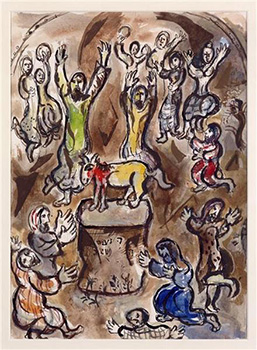
Marc Chagall, The Adoration of the Golden Calf (1966).
|
These are pretty radical statements, and sometimes when I read them I feel all kinds of opposition arising in myself. There is so much that needs to be forgiven — so much sin everywhere, including inside myself. How can this possibly be?
Then I remember the struggle that Julian herself went through on this very subject. She writes, “I wondered and marveled with all the diligence of my soul. I said to God, ‘Good lord, I see that you are very truth, and I know truly that we sin grievously all day and so are blameworthy. And I cannot leave the knowing of this truth, nor can I unsee the showing that we are given no manner of blame.’” My question is like her question: “How can this be?”
The answer that she is given in the end is a vision of God’s love that is so complete that it excludes everything that is not love. “God is nothing but goodness. Our soul is oned to him — unchangeable goodness.”
If that is the case, then where does all of this talk about God’s wrath come from? Julian’s answer again is simple: it comes from us. We are the wrathful ones. We project that wrath onto God, who is all love.
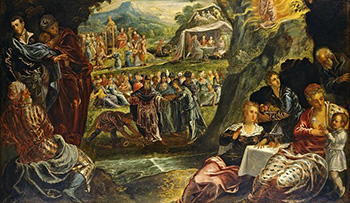
If we read Exodus 32 through this lens, I wonder how it changes what we see. In this story, Moses has gone up the mountain and has not come down again. For all the people know, he might be dead. Feeling like they are losing their way on this trek across the wilderness, they ask Aaron for some gods. Better gods of their own making than no god at all. Aaron complies and makes the golden calf out of their very own jewelry, and the people prepare to celebrate. Finally, a god they can see.
 |
|
Tintoretto, The Worship of the Golden Calf (c.1560).
|
Meanwhile, up on the mountain, where Moses is communing with God, God notices what the people are up to, and he is furious. He tells Moses, “Let me alone so that my wrath may burn hot against them” (Exodus 32:10).
Instead of obeying God, Moses begins to tell God his own story. Do we have to remind God of God’s love for us? Moses certainly thinks so. That creates some of the power and even humor in the story. Moses answers God by reminding him of all that has already been done on the people’s behalf and what a waste it would be to lose all of that. “But Moses implored the Lord his God and said, ‘O Lord, why does your wrath burn hot against your people, whom you brought out of the land of Egypt with great power and a mighty hand?’” (Exodus 32: 11). Eventually Moses talks God down and God “changes his mind about the disaster that he planned to bring on his people” (Exodus 32:14).
So what do we make of this? Julian would draw our attention to the reason that all of this business with the golden calf transpired in the first place: the people lost sight of God. Moses had gone up the mountain, and he had not come down. The people started to worry that they had been abandoned.
She writes, “We are frail and unwise in ourselves, and during this time our will is also overcome. We are in tempest, and in sorrow and woe. And the cause is blindness. We cannot see God.” If we were able to see God, we wouldn’t, even for an instant, consider mischief like making idols for ourselves. But in our blindness and in the pain that it causes, we forget to seek after God. And from this flows all manner of trouble.
 |
|
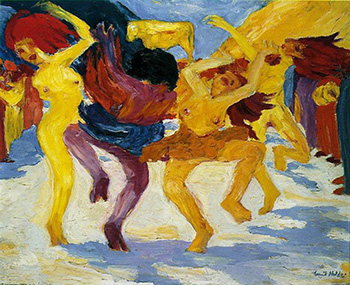
Emil Nolde, Dance Around the Golden Calf (1910).
|
Julian’s God would feel distress that the people have settled for cold metal instead of overwhelming and all powerful love.
But not seeing God is also a good thing. It creates inside us a longing for God, and that longing allows mercy and grace to work in us. When we project our wrath onto God, then God has one and only one thing to forgive us for: imagining our wrath as God’s wrath. I imagine that Julian would see the story of Moses and the wrath of God as the story of our painful and unending learning that God is all love and that we are all one in God’s love. This is a long journey, not an immediate recognition and in our human frailty, we forget and we fail.
But mercy and grace continue their work in us, unfailingly. God did keep showing up for the people in the wilderness, just as God does in the wilderness of our own lives. Julian writes, “Mercy works — keeping us, accepting us, bringing us into life, healing us — and all this is from the tenderness of love. And grace works with mercy — raising us, rewarding us (far beyond what even our own love and labor deserves), spreading widely, and showing the high, abundant, and generous hospitality of God’s royal lordship, in his astonishing courtesy. And this is love’s abundance.”
Weekly Prayer
Juliana of Norwich (1343–1416)
The love of God most High for our soul
is so wonderful that it surpasses all
knowledge. No created being can fully know
the greatness, the sweetness, the
tenderness, of the love that our Maker has
for us. By his Grace and help therefore let
us in spirit stand in awe and gaze, eternally
marvelling at the supreme, surpassing,
single-minded, incalculable love that God,
Who is all goodness, has for us.
Julian of Norwich (1343–c.1416) was an anchoress at St. Julian’s church in Norwich and the author of the first book written by a woman in English, A Revelation of Love.
Amy Frykholm: amy@journeywithjesus.net