
From Our Archives
For earlier essays on this week's RCL texts, see Dan Clendenin, Should We Pay Taxes? (2023); and Debie Thomas, What Belongs to God (2020).
By Amy Frykholm, who writes the lectionary essay every week for JWJ.
Psalm 24:1: “The earth is the Lord’s and everything in it.”
For Sunday October 18, 2026
Lectionary Readings (Revised Common Lectionary, Year A)
Psalm 99 or 96:1–13
1 Thessalonians 1:1–10
Matthew 22:15–22
Several years ago, my husband was in a library in Bamako, Mali when a woman came around to serve lunch to everyone. When she brought a plate of chicken stew and rice to Peter, he hesitated. He hadn’t ordered lunch. He wasn’t an employee or a visiting dignitary. When he tried to tell the woman that he didn’t think he was included in the lunch, she looked at him quizzically. “All food belongs to Allah,” she said, setting down the plate next to him.
All food belongs to Allah — that is, everything that nourishes us, everything that keeps us alive, every resource on the entire earth is God’s. As Psalm 24 says, “The earth is the Lord’s and everything in it.”
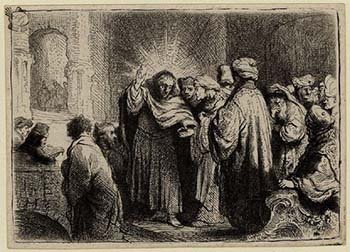
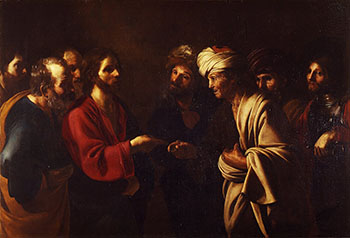
So when the Pharisees come to Jesus with their trick question about whether or not to pay taxes to Caesar, this is the context of his reply. He offers them a bigger picture by starting with the little picture: “Whose head is this and whose title?” he asks (Matthew 22:20). When they notice that it is Caesar’s head, he says one of the most famous lines in the New Testament, “Give to Caesar the things that are Caesar’s and give to God the things that are God’s” (22:21). He offers a subtle and careful commentary on God’s economy. So Caesar printed a coin with his head on it — how does that change the fact that everything already belongs to God?
I once interviewed someone who said with great certainty, “We don’t need churches starting soup kitchens. What we need are churches strong enough and brave enough to dream an end to the soup kitchen. Churches that will join the fight for economic justice. No one should have to beg at someone else’s table.” I imagined it a moment. Having enough to eat. Not needing the company of others. Each person sufficient unto themselves. Not needing to ask for help. That’s how I interpreted this person’s version of justice and equality. The perfect peace of self-sufficiency. And I thought, “I understand what she’s saying, but I don’t think that’s my view of God’s economy.”
 |
|
Rembrandt, The Tribute Money (1635).
|
Some years ago a woman came in to my church while I was working in the kitchen. She was young and pregnant with one child, while another was on her hip. She and her husband had traveled from Alaska, and now they had nothing. She trembled as I filled a box with food. It seemed like asking for help had taken the last bit of everything that she had, and now she was shaking as she tried to hold pieces together. She tucked a strand of black hair behind her ear and rubbed a hand against her pierced nose. Her need seemed to have startled and embarrassed her, and I thought of the many times that my need has startled and embarrassed me.
I filled the box with peanut butter, spaghetti, and apple sauce. “How about tuna fish?” I asked. What I wanted to say was, “It isn’t the end of the world to need something. It really isn’t. It’s just a chance to open a little wider, to build relationships. Anyway, you’re not taking anything that isn’t already yours: all food belongs to Allah.” But I didn’t say that because I thought it might make her feel even more awkward.
Instead of imagining a world without soup kitchens, I imagine a vast expansion of soup kitchens, the world as one great soup kitchen, where the food —Elsa’s potato dumpling soup or Ali’s Thai vegetable soup or Randy’s green chile or Silvia’s Salvadoran bean soup that she serves with pupusas and spicy, pickled vegetables — is served at a table that isn’t your table or my table, but belongs equally to everyone. It’s available twenty-four hours a day, for anyone to come and eat. And let’s say there is a place at the table for you and me. We don’t have to make conversation, but we can if we want to. We can carry our bowls out onto the steps in the sunshine or sit hunched over in the corner. We can talk politics and religion or tend our own silence. But we are there, and everyone is there, equally welcomed, equally fed.
 |
|
Bartolomeo Manfredi, Tribute to Caesar (1650).
|
In his book Dostoevsky, Rowan Williams asks “whether we can imagine a human community of language and feeling in which, even if we were incapable of fully realizing it, we knew what was due to each other, whether we could imagine living in the consciousness of a solidity and depth in each other which no amount of failure, suffering, and desolation could eradicate.” I feel like this is the vision that is hiding in the moment when Jesus flicks the coin back to the Pharisees. “We don’t need that,” he says. “We have other ways of providing for our needs.”
Botanist Robin Wall Kimmerer identifies something in our own Caesar-based society that she calls the “Windigo economy.” The Windigo is a mythical figure in many Native American mythologies who is a greedy, self-absorbed, hungry demon who has to consume everything in sight. She sees the Windigo when she looks at how our current market system works. “The market system artificially creates scarcity by blocking the flow between the source and the consumer. Grain may rot in the warehouse while hungry people starve because they cannot pay for it. The result is famine for some and diseases of excess for others. The very earth that sustains us is being destroyed to fuel injustice. An economy that grants personhood to corporations but denies it to the more-than-human beings: this is a Windigo economy.”
 |
|
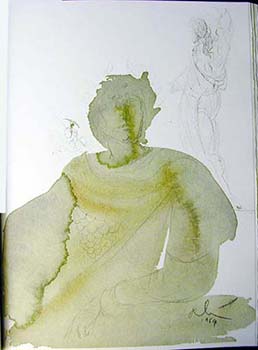
Salvadore Dali, Licet tributum dare Caesari? (1967).
|
The alternative to the Windigo economy is gift and gratitude: “A deep awareness of the gifts of the earth and of each other is medicine. The practice of gratitude lets us hear the badgering of marketers as the stomach grumblings of a Windigo. It celebrates cultures of regenerative reciprocity, where wealth is understood to be having enough to share and riches are counted in mutually beneficial relationships. Besides, it makes us happy."
Volunteers who come to help us at the Community Meal are often hesitant to partake of the incredible abundance that we experience there. “I don’t want to take food out of someone else’s mouth,” I’ve heard more times than I can count. “I don’t really need it.” But I think this is a misunderstanding. We are all included in God’s regenerative reciprocity. We all are invited to the table. And when we partake, we have the opportunity to keep God’s gifts moving through the world. We build mutually beneficial relationships. We connect. Often the first step is acknowledging our own need and being willing to receive.
Weekly Prayer
Gregory Orr (b.1947)
The world comes into the poem,
The poem comes into the world
Reciprocity—it all comes down
To that.
As with lovers:
When it’s right you can’t say
Who is kissing whom.Gregory Orr (b.1947) is an American lyric poet and essayist who founded and directed the creative writing program at the University of Virginia for many years. He’s received numerous awards for his poetry including a Guggenheim award, NEA fellowships, and two American Academy of Arts and Letters awards. This poem is from his book Concerning the Book That Is the Body of the Beloved (Copper Canyon Press, 2005).
Amy Frykholm: amy@journeywithjesus.net
Image credits: (1) WikiArt; (2) Wikipedia.org; and (3) WikiArt.



#/media/File:Bartolomeo_Manfredi_-_Il_tributo_a_Cesare_-_Google_Art_Project.jpg)