From Our Archives
For earlier essays on this week's RCL texts, see Michael Fitzpatrick, Souls and Saints (2023); and Debie Thomas, The Great Reversal (2020).
This Week's Essay
By Amy Frykholm, who writes the lectionary essay every week for JWJ.
Revelation 7:17: “He will guide them to springs of the water of life.”
For Sunday November 1, 2026
Lectionary Readings (Revised Common Lectionary, Year A)
Psalm 34:1–10, 22
1 John 3:1–3
Matthew 5:1–12
When I moved to Leadville, Colorado 26 years ago, one of the first people I noticed was a weathered man who frequently sat on the steps of his house in the afternoon sun. His house alone was enough to attract attention. It was an old Victorian on the main street with a wide porch in considerable disrepair. Over one door, a hand-painted sign read, “Welcome to Divine Cosmology Museum; Divine Spirit Over Matter; Energy. 5.24.91.”
At the time all I was really able to take in was the fact that Cosmos, the man on the steps, was a bit of an oddball, and I had mixed feelings about whether I’d want to see inside the museum or not. He also decorated his front yard with a variety of stone cairns. At the top of each stack were painted rocks with sayings about Divine Life, Blessing, Divine Wisdom, and Gravity (Without Gravitation is Matter! Blessing on you!).
 |
|
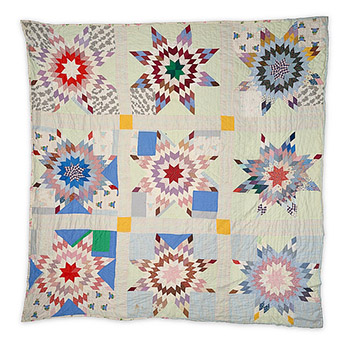
Agatha P. Bennett, Stars, Nine-Block Variation (1970).
|
Gradually, I learned that Cosmos was something of a living legend. He had moved to Leadville in 1988 and spent at least one winter camping outdoors to acclimate himself to the cold. He came to Leadville, legend has it, to help people run the Leadville Trail 100 foot race. His mind-over-matter training prepared him to help racers with this grueling event, and he became a training guru. The Leadville Trail 100 is a rugged hundred-mile running race that takes place every August over the course of 30 hours. It takes runners up to 12,000 feet of elevation, back down to 9,000 and up again to 12,000. For most humans, simply completing this race is the challenge, more so than winning it. Cosmos would help runners negotiate the psychological challenges of exhaustion and pain.
He was born in Bulgaria, the child of Armenia refugees, and studied physics, philosophy, and astronomy at a university in Sophia. After his graduation, he started traveling throughout Europe and Asia, working as an entertainer who performed feats of human endurance. He eventually arrived in New York, where he opened a health food store and established a school that he called “The Ultimate Cosmic Holy Temple.” Newspaper records of the time show Cosmos performing feats of endurance on Times Square, including laying on a bed of nails while being run over by a Cadillac, and so on.
He chose Leadville, he told a local writer, because he wanted to be closer to the sun, the source of all life. His house became “The Temple of the Living God Cosmos.” As he grew older, that’s where you could find him: on his steps, soaking in the sun. One day when my son Sam was in first grade, we were walking home from school. As we walked past Cosmos’s house, Sam said, “I want to make Cosmos some cookies.” So we went home and baked cookies and carried them back to Cosmos, who was still sitting outside. Sam had understood intuitively that Cosmos probably only ate very healthy cookies, so he had carefully written out the ingredients for the cookies on a card he had included.
 |
|
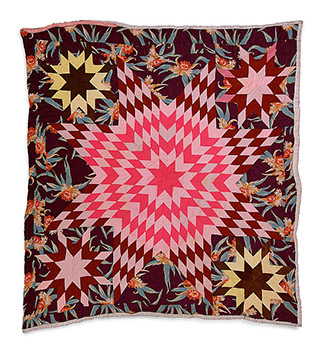
Ella Mae Erby, Texas Star (1973).
|
Sam shyly approached the steps and offered Cosmos the package of cookies. Cosmos smiled. “Ahh,” he said. “I will only have one.” He selected a cookie from the package and ate it. Then he said to Sam, “I wish everyone could see the world through your eyes. Would you like to come to my museum?” The next day, we went back to Cosmos’s house for a tour.
Cosmos died last Saturday at the age of 92, and he’s been uppermost on my mind as we come toward All Saints Day. I have two competing ideas of what a saint is, and they converge on Cosmos. On the one hand, I understand that a saint is a person who lived an exemplary life — a life that set an example. In Cosmos, I see a person who lived life according to a deeply held inner compass. He lived, so far as I could see with my eyes, a life of integrity and kindness. Indeed a life worth emulating.
But my other idea of a saint is simply a person who went before us, an ancestor. And I see this in Cosmos as well. Cosmos came to Leadville at a time when many thought the town was dying. The nearby mine had closed, and people were leaving so fast, the old-timers say you could stand on the edge of town and wave as they drove off. It wasn’t at all clear at that moment what a new Leadville would look like, who would inhabit it, if new life could be found. Quietly, day by day, Cosmos helped to create the town that I now inhabit. By his living, he helped us to see where we were and who we were. And most of this he did simply by sitting in the sun and talking about the mysterious nature of endurance.
 |
|
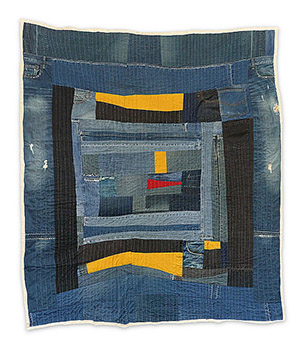
Loretta Pettaway Bennett, Return to Gee’s Bend II (2022).
|
Just now, I walked over to Cosmos’s house to get another look at his painted rocks, and I was a little surprised to see that people had quietly and anonymously covered his front gate and his steps with flowers, flowers that had withered quickly in the cold, but were a testament to his legacy.
I was reminded of a story in John Philip Newell’s book A New Ancient Harmony about a dream he had. In the dream, many people had been given circles of fabric, and they were supposed to form, out of these circles, one great circle, with no gaps. “It was like a giant jigsaw puzzle in which every piece was to fit perfectly together.” At first, no one could figure out how to do it, and there was a lot of frustration. Eventually people realized they could fold and reshape their circles, and what began to emerge was a single interconnected pattern.
Where does the pattern come from? How do we all fit? What are we making together? Newell’s dream raises more questions than it answers, but it seems like a dream suited to All Saint’s Day. Perhaps it is a colorful and vibrant version of the one we have in Revelation: “a great multitude that no one could count, from every nation, from all tribes and peoples and languages, standing before the throne and before the Lamb, robed in white, with palm branches in their hands” (Revelation 7:9).
We do fit. We are part of one fabric and one pattern. All Saints Day offers a moment to pause and remember the vibrant colors of those who have gone before us.
Weekly Prayer
Jane Wilson Joyce
Crazy Quilt
The Liberty Bell in Philadelphia
is cracked. California is splitting
off. There is no East or West, no rhyme,
no reason to it. We are scattered.
Dear Lord, lest we all be somewhere
else, patch this work. Quilt us
together, feather-stitching piece
by piece our tag-ends of living,
our individual scraps of love.Jane Wilson Joyce retired in 2012 as Luellen Professor Emerita of Classics at Centre College in Kentucky. A classical scholar with wide-ranging interests, Joyce regularly taught classes in Latin language and literature, ancient epic and lyric poetry, Greco-Roman drama, classical mythology, and creative writing. This poem comes from her book The Quilt Poems (1984).
Amy Frykholm: amy@journeywithjesus.net
Image credits: (1) Souls Grown Deep; (2) Souls Grown Deep; and (3) Souls Grown Deep.