From Our Archives
For earlier essays on this week's RCL texts, see Dan Clendenin, On Israel and Palestine (2023); and Debie Thomas, The Greatest Commandments (2020).
This Week's Essay
By Amy Frykholm, who writes the lectionary essay every week for JWJ.
Psalm 90:5: “You sweep the days away; they are like a dream, like grass that is renewed in the morning.”
For Sunday October 25, 2026
Lectionary Readings (Revised Common Lectionary, Year A)
Psalm 90:1–6, 13–17 or Psalm 1
1 Thessalonians 2:1–8
Matthew 22:34–46
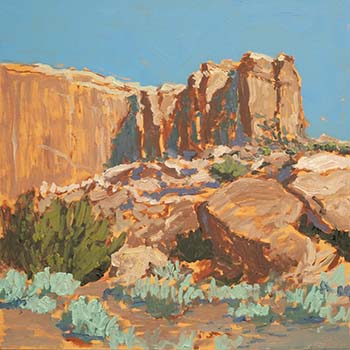
Miriam took us along a main highway to a pull-off we probably would never have seen on our own. The entrance to the trail was covered by willows, and we ducked through them to find a path along an enormous sandstone wall.
“How did you find this place?” I asked her.
“Oh, just wandering around as I always do.”
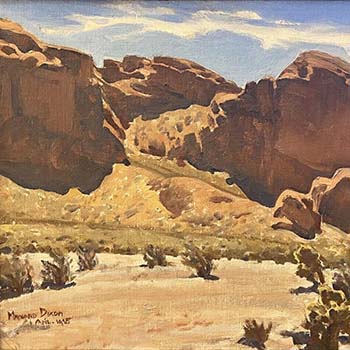
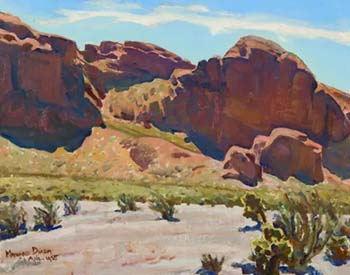
We were in Moab, Utah surrounded on all sides by geologic wonders, by the remnants of wind and rain on rock, millions of years old. There is no other landscape that can compel from me a perception of the grand sweep of geologic time.
If my thoughts ever turn apocalyptic, I can go to these wild and strange desert formations and feel what the psalmist is saying in Psalm 90. “Before the mountains were brought forth or ever you had formed the earth and the world, from everlasting to everlasting you are God. You turn us back to dust.”
Clouds were building — the remnants of Tropical Storm Rachel — and Miriam was keeping a close eye on the sky. As naturalist Craig Childs says, there are two paradoxical ways to die in the desert. One is lack of water, and the other is drowning in sudden flash floods through arroyos. “If there’s thunder,” Miriam said in her laconic way, “I’m turning around.”
 |
|
Thomas Windsor, Bright Desert Cliffs (2026).
|
She led us deep into the red rock to a natural amphitheater where, she said, secret music festivals sometimes take place, then up a kind of crumbling staircase hewn into the rock, that she thought sheepherders might have made at some unknown time past.
Once we ascended the staircase, we were on a plateau. To one side was the same rock wall we’d walked along down below, still towering hundreds of feet above us, and to the other, the Colorado River Valley. On the rock wall, humans had left evidence of their fleeting existence. There were petroglyphs of an eagle and a spiral, as well as the names of people who had felt compelled to testify to their impermanence. “Robert 1962.”
A cactus thorn found its way into my shoe, and when I reached in to pull it out, I bled.
Everywhere there were reminders of just how ancient the landscape is and just how dustlike we are upon it. “What geologic layer is this?” someone asked Miriam. “It’s mostly Entrada, I believe,” she said squinting up, her white hair splaying on all sides from her cap. Entrada Sandstone is a rock formation deposited somewhere between 180 and 140 million years ago, young in geologic time.
We looked down and saw a tiny boreal toad, no bigger than a pencil eraser. For several minutes, we watched mesmerized as it navigated the rocks and vegetation. Later we saw the clear and recent print of a juvenile bear in the sand.
I feel simultaneously alive and insignificant when hiking in the desert. How does anything that I do matter? And yet, simultaneously, I wonder what petroglyph of my life am I going to leave and how many generations will it take until it fades to indecipherability.
 |
|
Maynard Dixon, Desert Rocks (1915).
|
The lectionary readings for this week are full of contradictory information about the value and significance of our lives. On the one hand, Moses could stand on Mount Nebo and look out over the Promised Land he had brought the people so far to see. On the other hand, he could not cross into it. On the one hand, God is “our dwelling place in all generations” (Psalm 90:1). On the other hand, we are nothing but grass.
In the gospel, Jesus asserts the significance of two impossible commandments. One is to love God “with all your heart and all your soul and all your mind” and the other is “love your neighbor as yourself” (Matthew 22:37–39). For me, coming out of the desert as I just did, I feel the paradox of our capacity for love. We are commanded to love, inspired to love, placed in the midst of love at all times. Love is the strongest force in the universe, the scriptures say. And at the same time, love feels like a force just about as significant as that tiny toad — mostly invisible.
Somehow, despite our fragile and ephemeral standing in geologic time, it matters how we live our lives, where we root them. This feels mysterious to me. Maybe it is because, as Pierre Teilhard de Chardin writes, “we are surrounded by ideas and objects infinitely more ancient than we imagine, and yet at the same time everything is in motion.”
From observing the world, we learn, as the psalmist does, that love is nothing if not a process, and we are not so much beings as we are becomings.
Even more than that, I hear Teilhard’s word “imagine,” and I think this word is one that makes the “greatest commandments” so difficult. We are asked to love what we cannot know and cannot even imagine, and we are asked to love that with everything we are.
 |
|
Maynard Dixon, Desert Rocks No. 2 Camelback Mountain (1925).
|
That’s the first commandment, and Jesus says somewhat mysteriously, “the second is like it,” to love our neighbor as ourself. Here the mysteries multiply. The psychoanalyst-philosopher Jacques Lacan wrote extensively about this commandment, noting that our neighbor is not just another human, but a being that we can never know completely or fully.
Other people carry an unsettling, uncanny otherness that we can never feel at ease with, Lacan says. They have an interiority — thoughts and feelings, tastes and perceptions — that are not our own. And the same thing is true about ourselves: if we are loving other people the way we love ourselves, then we are being asked, once again, to love a mystery. We don’t even know ourselves. We find ourselves uncanny and strange, unknowable and always changing.
One follower of Lacan, philosopher Richard Boothby, wrote that the revolutionary aspect of Christianity was Jesus’ demand that we notice that our neighbors were real human beings — not concepts, not tribal members, but unknowable and mysterious others, like ourselves. “The teaching of Jesus turns every person we meet into a burning bush,” he wrote.
We got back to our cars just as it started to rain. It rained all night. The Moab 240 — an ultramarathon race — was canceled when 70 runners and volunteers were stranded at a remote aid station that night because of flooding waters and falling trees.
The next morning, the desert bloomed.
Weekly Prayer
A Blessing from A Black Rock Prayer Book.
The world now is too dangerous and too beautiful
for anything but love.
May your eyes be so blessed you see God in everyone.
Your ears, so you hear the cry of the poor.
May your hands be so blessed
that everything you touch is a sacrament.
Your lips, so you speak nothing but the truth with love.
May your feet be so blessed you run to those who need you.
And may your heart be so opened, so set on fire,
that your love, your love, changes everything.
And may the blessing of the God who created you, loves you,
and sustains you, be with you now and always.A Black Rock Prayer Book is a compilation of prayers developed in the context of the Burning Man Festival.
Amy Frykholm: amy@journeywithjesus.net
Image credits: (1) Thomas Windsor Studio; (2) eBay; and (3) Scottsdale Art Auction.