From Our Archives
For earlier essays on this week's RCL texts, see Dan Clendenin, Naming Where We Are (2023); Debie Thomas, Because You Hid Yourself (2020); and Liz Milner, Poetry From Prison: Advent Hope (2017).
This Week's Essay
By Amy Frykholm, who writes the lectionary essay every week for JWJ.
Mark 13:37: “And what I say to you I say to all: Keep awake.”
For Sunday November 29, 2026
Lectionary Readings (Revised Common Lectionary, Year B)
Psalm 80:1–7, 17–19
1 Corinthians 1:3–9
Mark 13:24–37
During the height of the pandemic in my little town, one night my husband called from his workshop. “Go outside,” he said. “Look up.” I went out and looked into the night sky where I saw a train of lights, each one like an individual star, but moving in a deliberate pattern across the sky and then disappearing into the darkness. It looked like an army of aliens moving into formation — or at least that was one of my first thoughts.
The night was clear and still cold. The street was quiet in a way that things were only quiet during the pandemic. “If I was an apocalyptic thinker,” my husband said, “I would be pretty scared right now.” There was something eerie about watching those lights move across the sky without name and with an unknown purpose. At that point, neither of us had heard of Starlink, and it wasn’t a part of our daily lives. But humans have been looking up at the sky and making meaning from what they see for tens of thousands of years, often with fear and trembling, and watching the night sky change in front of my eyes stirred ancient anxieties. (I’m not saying that I necessarily felt better about it once I understood what that parade of lights was, nor have recent developments with Starlink left me feeling peaceful and at ease about the night sky.)
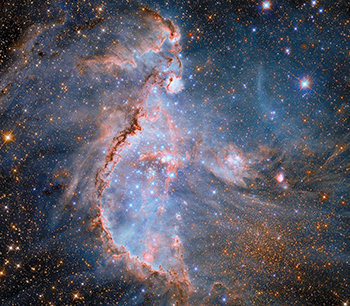
Our Advent lectionary readings begin with looking up. The season of Advent turns our attention to sky-oriented things: the permanence of the stars and celestial bodies and the passing nature of the clouds. Both Isaiah 64 and Matthew 25 draw our attention to the heavens. Isaiah sounds a note of longing: “O that you would tear open the heavens and come down, so that the mountains would quake at your presence” (Isaiah 64:1), while Mark’s tone sounds more like a warning: “But in those days, after that suffering, the sun will be darkened, and the moon will not give its light, and the stars will be falling from heaven, and the powers in the heavens will be shaken” (Mark 13:24-25).
 |
|
Hubble Telescope Image from NASA.
|
While these two images share the sun, the moon, and the stars, they are quite different in tone. One of them is wrenched with a desire that seems to hover on the verge of despair. It calls for an action of God that would make sense of a world already gone dark in ways that have nothing to do with the skies. The other sounds predictive: here are the things that will happen. Both are shot through with a question about the presence of God. In Isaiah, God’s presence is the one that would make the mountains shake, while in Mark, we only know that God’s presence is “near, at the very gates” (Mark 13:29). Mark’s predictive tone ends with an admonition that seems vital in Advent: Keep awake! (Mark 13:35). The Messiah is coming. Will we notice or will our fears, anxieties, and the uncertainty that forms our everyday lives be too distracting?
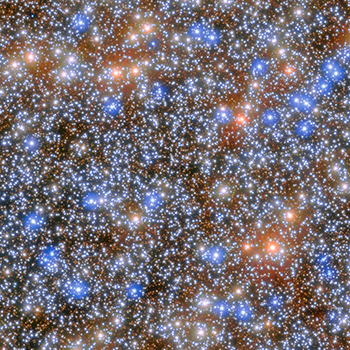
The other impulse of Advent, however, is not to look up but to look within. As the days grow shorter and the nights grow longer, we feel compelled to turn to introspection, self-examination, even wonder. Advent seems to say that the signs of the Messiah’s coming are not out there in the heavens somewhere, or at least not only out there. They are inside the human heart. Look within, this other impulse says. The signs we are looking for are found there. The conditions that will allow us to cultivate awareness are internal conditions.
 |
|
Hubble Telescope Image from NASA.
|
And yet, before we wax too poetic on these conditions, it seems imperative to note that both of these Advent impulses are at odds with the cultural demands that the season places on so many of us. There’s no time to look up or look within. We’ve got lists of things to do, events crowding the calendar, travel to plan, gifts to buy, stewardship campaigns to organize, end-of-year letters to write. We’ll be lucky if we have a chance to catch our breath before the New Year.
I was surprised, years ago, to learn that in Orthodox Christianity, Advent is called “Little Lent.” It’s a period of fasting and preparation that belies our own cultural Christmas preparation madness. I remember clearly where I was when I learned this. The year was 1991, and I was in a small city in southern Russia in the kitchen of a woman named Olga Nikolaevna. She was preparing a traditional salad that we had eaten many times over the months we had been in Russia: boiled beets, carrots, potatoes, and dill.
Outside the steamed-up windows of this tiny kitchen in a Soviet apartment building, the Soviet Union was collapsing. Its official end was just days away. Inside, Olga Nikolaevna was explaining that because we had now entered Little Lent, she would prepare the salad without its traditional mayonnaise dressing or bits of baloney to flavor it. For the period of Advent, she would refrain from dairy and meat.
I tried to imagine how that would work at home — how utterly counter-cultural it would be to refrain from dairy and meat during Advent. I thought of the Christmas parties, the holiday cookie exchanges, the traditional Christmas treats that were so much a part of the season and that I was missing for the first time in my life as I sat in that kitchen. How radical and strange — and maybe terrible — it would be to withdraw from all of that and turn inward in a more Lent-like fashion.
 |
|
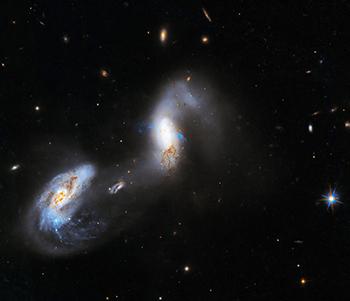
Hubble Telescope Image from NASA.
|
But I could also see how the act of fasting that Olga was entering — during a moment when the world she had always known was collapsing — would allow her to look up and look within in a deep sense. She was preparing herself for a cycle of death and rebirth that was more ancient than any political structure; she was preparing herself for the coming of Christ. She was perhaps searching for what the prophet Isaiah called “the treasures of darkness and riches hidden in secret places” (Isaiah 45:3).
Our Christmas season seems designed to drive out the darkness instead of welcoming it. Keep it noisy, keep the lights burning brightly, don’t give the darkness any foothold. But the Advent imperatives remain. “In this strange season when we are suspended between realization and expectation, may we be found honest about the darkness, more perceptive of the light,” writes the late theologian Jack Boozer. To do that, we have to bring together those two gestures: looking up and looking within. Both of them acknowledge galaxies that exist beyond and within us, a vaster space than the ones that we imagine we are in control of. To allow light to be born within, we might have to allow the darkness first, to appreciate it and learn to walk in it.
Weekly Prayer
Jan Richardson
Move over the face of
my deep,
my darkness,
my endless restless chaos,
and create,
O God;
trouble me,
comfort me,
stir me up,
and calm me,
but do not cease
to breathe
your Spirit into
my wakening soul.Jan Richardson is an artist, writer, and ordained minister in the United Methodist Church. She serves as director of The Wellspring Studio, and has traveled widely as a retreat leader and conference speaker. Known for her distinctive intertwining of word and image, Richardson’s work has attracted an international audience drawn to the welcoming and imaginative spaces that she creates in her books, blogs, and public events. This poem is from Night Visions: Searching the Shadows of Advent and Christmas (United Church Press, 1998).
Amy Frykholm: amy@journeywithjesus.net