From Our Archives
For earlier essays on this week's RCL texts, see Dan Clendenin, She Crushed His Head (Reading the Bible’s Violent Verses) (2023); Debie Thomas, The Good Kind of Worthless (2020); and Ed Rommen, Reflections on Last Things (2017).
This Week's Essay
By Amy Frykholm, who writes the lectionary essay every week for JWJ.
Matthew 25:24: “I went and hid your talent in the ground.”
For Sunday November 15, 2026
Lectionary Readings (Revised Common Lectionary, Year A)
Psalm 123 or Psalm 90:1–12
1 Thessalonians 5:1–11
Matthew 25:14–30
Years ago my Episcopal priest tried an experiment. For the lectionary Sunday when we read the parable of the talents in Matthew, she made a tiny origami box for each person who was in church. I still have my little box, and it is sitting beside me as I write this. Inside the box, she placed $20. As a part of the sermon, we each received the box and the money and were instructed to meditate on the parable and choose what to do with our $20.
As you may recall, in this parable a master is going on a journey. Before he leaves, he gives property to each of the servants in the form of “talents,” “according to his ability” (Matthew 25:14). A talent was a unit of measurement for a large amount of precious metal. The first servant takes the five talents he receives and sets off, makes some clever trades, and comes back with an additional five talents. The next one is given two, and he sets off and makes two more talents. These servants are praised and rewarded by their master. The last servant is given one talent. He buries it in the ground. When the master returns, he gives it back to the master, having achieved no gain, and is called “worthless.”
I took my little box home and set it on my window sill. I wanted to think of something creative to do with the money. I wanted to do something — as I thought the parable suggested — that would be an investment, that would lead to more flourishing. I wanted to be a “trustworthy” steward of the money, which the parable suggests involves growth.
 |
|
"The Three Servants" by Kazakhstan Artist Nelly Bube.
|
I could think of plenty of places to give $20. I knew a lot of people who could use it just to get through their daily lives. I knew a lot of worthy causes. But if I gave $20 to Mountain Bob, would that really lead to more flourishing in his life? If I added $20 to any of the causes I supported, would there be any way to tell that the money made a difference? How could I make my $20 lead to more well-being, more happiness, more life? With so many people and so much need lined up in front of me, I grew paralyzed. The box sat. The $20 sat in it. A week went by, then a month, then two months and three. Still I had no insight into how to use the money.
It wasn’t long before I recognized in myself the “wicked servant” who hid the money in the ground. When asked about it, he said, “Master, I knew that you were a harsh man, reaping where you did not sow and gathering where you did not scatter, so I was afraid, and I went and hid your talent in the ground. Here you have what is yours” (Matthew 25: 24–25). Wasn’t that just exactly what I was doing: hiding the money in the little box? Was it fear, perfectionism, do-gooder-ism that held me in its grasp?
I also noticed, however, that I felt a lot of compassion for that man as I saw myself in him. He didn’t know what to do. Maybe overthinking got the best of him too. That happens to all of us, I thought. Paralysis is no fun. By contrast, making money from money, investing, profiteering, watching something thrive because you invested in it is certainly fun.
I also began to notice in me an impatience to be done with the question and to be done with the money. Inspiration had not struck. I had no brilliant ideas. I began to feel resentful of the task and not a little angry with the servants who had found it so easy to go off and make more talents. I would have been thrilled with the master’s solution: “take the talent from him and give it to the one with the ten talents” (25:28). Please just take this off my hands!
 |
|
The Parable of the Talents, Speculum Humanae Salvationis, 14th century.
|
My story of the talents has just about as unhappy an ending as the story in Matthew. I took the money back to the church and anonymously put it in the donation box. No one had to know, I thought, that I had failed such a simple task. Might as well send the money back to where it came from. I guess it’s the “outer darkness” for me (25:30).
But now, reading the parable again these decades later, I see that I missed some tiny little words at the very beginning of the parable. “For it is just like a man about to go on a journey…” (25:14). This is not a kingdom of heaven parable. The previous parable — about the oil lamps and the bridegroom — is a kingdom of heaven parable and begins, “Then the kingdom of heaven will be compared to…” (Matthew 25:1).
Here the story begins with an indication that Jesus sees and knows the system of exploitation in which his listeners are embroiled, to which they’ve lost their land, their livelihoods, and the fruits of their labor. (See Debie Thomas’s essay “The Good Kind of Worthless” for a clear explanation of this system.) He knows the price they’ve paid for the wealth of others.
It is striking that Jesus’ final parable in the Gospel of Matthew isn’t about the pearl of great price or the irrepressible mustard seed or any of the other images of secret and unexpected flourishing at the heart of the kingdom of heaven. Instead it is about the all-too-real state of the world: the rich get richer and the poor get poorer. The master celebrates this system. “For to everyone who has, more will be given, and he shall have an abundance, but from the one who does not have, even what he does have will be taken away” (25:29). Not much has changed; a truer statement of our own economic moment would be hard to find. The worthless servant does not celebrate this system. He just suffers its consequences.
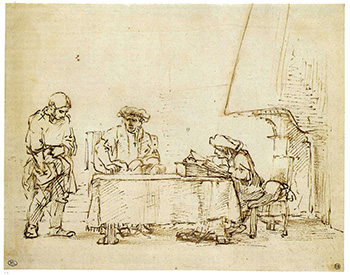 |
|
Rembrandt, The Parable of the Talents (c.1652).
|
Ironically, as I tried to enact the parable based on the mistaken idea that it was somehow about the creative use of resources, I could not. Instead I unwittingly played the part of worthless servant, while casting my much-loved priest in the role of the heartless master. Even though I am often one to say that there are many ways to read a parable, in this case, I can also see that one mistaken reading led to another mistaken reading until I lost the thread of grace entirely.
There is a difference between this servant and myself: he refuses to participate in the game he is being asked to play, out of an understanding of how it works. He’s relatively powerless in this system, but when he does have an opportunity to call it out, he uses that opportunity to tell the truth and to pay the price.
As I’ve reflected on that period of literal, parable enactment, I’ve remembered something that Richard Rohr writes in The Universal Christ. “If something goes to you with grace and can pass through you and toward others with grace, you can trust it is the choice of God.” Maybe the fact that grace was not flowing could have been my first clue.
Weekly Prayer
George Herbert (1593–1633)
Come, my Way, my Truth, my Life:
Such a way as gives us breath;
Such a truth as ends all strife,
Such a life as killeth death.Come, my Light, my Feast, my Strength:
Such a light as shows a feast,
Such a feast as mends in length,
Such a strength as makes his guest.Come, my Joy, my Love, my Heart:
Such a joy as none can move,
Such a love as none can part,
Such a heart as joys in love.George Herbert (1593–1633) was an English poet who came from an aristocratic family. At the age of thirty-six, he shocked his friends when he left Cambridge University to become a rector in Bemerton, a rural village near Salisbury, where he spent the rest of his short life. None of Herbert's poems had been published when he died, but upon his deathbed he gave them to his friend Nicholas Ferrar, asking them to be published only if they might help “any dejected poor soul.” Today scholars esteem Herbert as one of the most skilled and important poets of his day, some even suggesting that his work surpasses that of John Donne.
Amy Frykholm: amy@journeywithjesus.net
Image credits: (1) Pericope.org; (2) Blogspot.com; and (3) PubHist.com.