From Our Archives
For earlier essays on this week's RCL texts, see Dan Clendenin, “We’re Tired of War!” (2023); Debie Thomas, The Story of the Bridesmaids (2020); and Liz Milner, My Bad Dream (2017).
This Week's Essay
By Amy Frykholm, who writes the lectionary essay every week for JWJ.
Wisdom of Solomon 6:16: “She goes about seeking those worthy of her and she graciously appears to them in their paths, and meets them in every thought.”
For Sunday November 8, 2026
Lectionary Readings (Revised Common Lectionary, Year A)
Psalm 78:1–7 or Wisdom of Solomon 6:17–20 or Psalm 70
1 Thessalonians 4:13–18
Matthew 25:1–13
I was recently assigned cleaning duties at a large, urban soup kitchen. I was handed a blue rag and shown the buckets of slightly bleached water that I was to use to wipe down tables between guests. There were two of us assigned to this duty. The other was a friendly, regular volunteer who gave me this little piece of wisdom: “I like to think of my job as preparing the space for the next person rather than cleaning up after the person before.”
People streamed in — 269 before the evening was out. I wandered the tables, swiping here and there, talking with the guests. An older woman in a wheelchair caught my eye, and I found myself at her table wiping up a few crumbs as she started talking to me. “My name is Sharon Black Owl,” she said. “That’s my grandfather’s name. He would turn into an owl whenever the settlers were around and fly up into a tree.”
I stayed at the table, captivated. I wanted to know more about shapeshifting. I had a lot of questions. But just as I was getting up the courage to ask her, the evening’s supervisor tapped me on the shoulder. “Amy,” she said. “We’ve only got two people wiping tables tonight so I’d appreciate it if you would get to your task.” And so I did. I said goodbye to Sharon Black Owl and went back to work.
 |
|
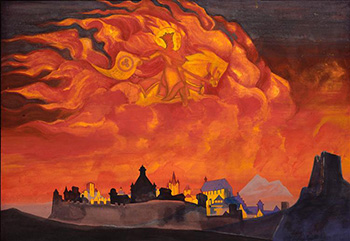
Nicholas Roerich, Saint Sophia the Almighty Wisdom (1932).
|
I’ve thought about this moment quite a lot since it happened, and even more since reading the parable of the ten young women in Matthew 25. The image is almost like a dream moment to me. The old woman with her wild white hair and deep black eyes feels like a person about to share some spiritual wisdom with me, as if we are both waiting for what poet Rodger Kamenetz calls The Great Opening, like the ten young women assembled to await the coming of the bridegroom.
And the interruption of this moment by the call of duty also feels like a dream moment: something comes to interrupt the moment of revelation. I’m called to duty, called back by my conditioning: you are here to do a job.
As I first started telling the story to myself, I blamed the supervisor for the interruption. I wished I had had the courage to say, “Actually, I am having an important conversation. I will get to the crumbs when I am finished.” But now I see how often my conditioning to duty calls me away from the potential of sacred encounter. The supervisor’s voice was just an audible version of my own interior voice: I always have another task to perform that prevents me from moving toward divine presence. Busy, busy, busy: that’s how I was trained.
But what was the better part of wisdom in that moment? Was it to wipe the tables or was it to pull up a chair and listen to Sharon the rest of the night, defying the supervisor’s tap on my shoulder? I honestly don’t know.
 |
|
Nicholas Roerich, Wisdom of Manu (1916).
|
This week’s lectionary texts give us two contrasting images of wisdom. In the Wisdom of Solomon, wisdom is everywhere and in every moment. Wisdom is there when I sat down with Sharon and wisdom was there when the supervisor tapped me on the shoulder. “[Wisdom] goes about seeking those worthy of her and she graciously appears to them in their paths, and meets them in every thought” (6:16). This image of wisdom seeking, appearing, and meeting is quite a contrast to the lack of appearance of the bridegroom and the seemingly cautionary tale about preparedness in Matthew 25.
But I immediately get snagged on that word “worthy.” And even though the word is never used, that seems to be the question in Matthew 25 as well. One reading of the parable certainly has the young women with oil in their lamps deemed worthy to enter the banquet hall. The ones without are left outside. I find myself wondering how many of the so-called wise young women thought privately, “Well, that was lucky. Just last week I ran out of oil and was out for days. I don’t deserve to be called wise.”
Spiritual preparedness is not like material preparedness. It’s not like having enough toilet paper in the cupboard the night before the Covid epidemic hits. It’s not making sure we have bottled water before the hurricane. It’s not the evacuation list of sacred items I tacked on my refrigerator during the wildfire that threatened my house this summer. While these things might be wise in a worldly sense, they are not indications of spiritual readiness.
 |
|
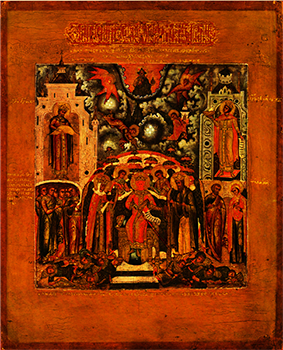
Anonymous, Sophia, Holy Wisdom (c.1625). |
In fact my encounter with Sharon Black Owl makes we wonder if those acts are actually the opposite of spiritual preparedness. I was prepared to wipe down the tables. That was my job. I wasn’t prepared to find myself torn between a sacred encounter and the job I’d signed up to do. Life is trickier and more unpredictable than any amount of oil collected in the name of being ready. Wisdom has many faces and can show more than one at any one time.
But it doesn’t matter how many times or in what guises Wisdom appears on your path if you can’t hear or see her. Something in us has to be ready. Maybe that something is vulnerability. Perhaps spiritual wisdom sits on our shoulder only when we’ve been broken enough to be open to what it brings. Perhaps it comes when we’ve been foolish enough times that we no longer rely on our own sense of preparedness.
In his book Seeing into the Life of Things, Kamenetz challenges us to consider what allows us to have a sacred encounter. It’s easy to walk by, to get distracted, to run off thinking we have to fill up our lamps (or wipe our tables). But life asks us to cultivate what Kamenetz calls “susceptibility, permeability.”
Perhaps then the admonition at the end of this parable, “Keep awake!” does not mean stay vigilant or be on guard. In the topsy-turvy world of parables, perhaps it means stay vulnerable, stay open, always wonder and be surprised.
Weekly Prayer
Mary Karr (b.1955)
I opened up my shirt to show this man
the flaming heart he lit in me, and I was scooped up
like a lamb and carried to the dim warm.
I who should have been kneeling
was knelt to by one whose face
should be emblazoned on every coin and diadem:no bare-chested boy, but Ulysses
with arms thick from the hard-hauled ropes.
He'd sailed past the clay gods
and the singing girls who might have made of hima swine. That the world could arrive at me
with him in it, after so much longing—
impossible. He enters me and joy
sprouts from us as from a split seed.Mary Karr (b.1955) is an American poet, essayist, and memoirist from East Texas. In three best-selling memoirs she has described her conversion "from blackbelt sinner and lifelong agnostic to unlikely Catholic."
Amy Frykholm: amy@journeywithjesus.net