From Our Archives
For earlier essays on this week's RCL texts, see Michael Fitzpatrick, For the Meek of the Earth (2022); Debie Thomas, "The Voice of One Crying" (2019); Arthur J. Ammann, Slogans vs Principles (2016); Ron Hansen, The Peaceable Kingdom (2013); Art Ammann, World AIDS Day 2010: Universal Access and Human Rights (2010); and Nora Gallagher, To Live in Longing (2007).
This Week's Essay
By Amy Frykholm, who writes the lectionary essay every week for JWJ.
Matthew 3:1: “In those days, John the Baptist appeared in the wilderness.”
For Sunday December 7, 2025
Second Sunday of Advent
Lectionary Readings (Revised Common Lectionary, Year A)
Psalm 72:1–7, 18–19
Romans 15:4–13
Matthew 3:1–12
Munther arrived early one morning at our Dead Sea resort hotel in Jordan. As he loaded our bags into a small white van, he announced with a smile, “We are going to a magical place. Wadi al-Hasa.”
We turned onto the long highway that ran along the Dead Sea and then turned up into the Jordanian mountains. I studied Munther. He was young, maybe late twenties, and was going to be our guide for the next three days. He had dreadlocks and a long beard, like a combination of my stereotyped ideas of a hippie and a jihadist. And he had warm, generous, sparkling eyes.
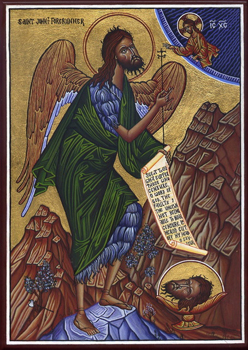
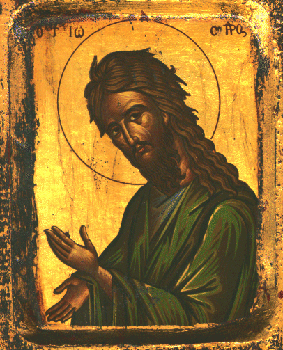
Or to put it another way, in light of the Gospel for this second Sunday in Advent, he looked like a locust-and-wild-honey type of guy. If I could extend my imagination enough to make John the Baptist into a self-deprecating, humble, and funny man with the wilderness etched into his very being, then I would say Munther looked like John the Baptist.
In fact, Wadi al-Hasa is in John the Baptist’s home territory, the wilderness beyond the Jordan. Wadi is the Arabic word for canyon. Wadi al-Hasa is the ancient borderline between the kingdoms of Moab and Edom. Archeological records of this place go back to the late Pleistocene period, 26,000 years ago.
Today, the wadi is a long, uninhabited valley that runs from the Jordanian highlands down to the Dead Sea. Its upper reservoir is used to prevent flooding of the Dead Sea valley. When Munther, my husband, and I started to hike it, we were stunned by its beauty. Oleander cascades off the cliff sides. The white limestone and red sandstone have looping markings that look like the mysterious writings of giants. For the vast majority of the hike, through narrow gorges and past waterfalls, we waded in the river itself.
 |
|
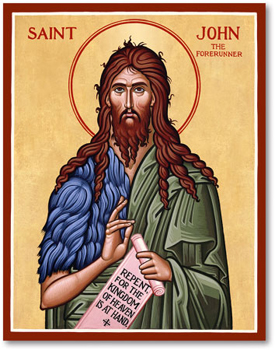
St John the Baptist icon.
|
While we hiked, Munther told us his story. He was the son of a prominent Jordanian family, and when he was a child he did not dream of becoming a wilderness guide. He dreamed of becoming a judge like his uncle. He excelled in his study of the Quran, and he was invited to attend summer camps and after-school programs to continue his training.
Then one day, when he was in high school, the leaders of his after-school Quranic studies program took the boys down into the mosque’s basement. There they showed the boys videos of members of the Islamic State. The boys were sworn to secrecy, but invited to become part of this ruthless movement.
Munther was stunned. For days, he followed his leaders’ orders and told no one, but he was haunted. Finally, he confessed what had happened to his parents. His parents forbade him from ever returning to that mosque.
But something deeper had changed for Munther after this experience, something that he didn’t have words for. He became colder to his faith, less trusting of it. He no longer wanted to become a judge, but as that plan fell apart, he didn’t have a ready replacement. He struggled in school, dropping in and out of university.
 |
|
St. John icon.
|
One day some friends invited him to go camping in the wilderness. He agreed, even though he really didn’t know what camping was or what people did in the wilderness. He laughingly recounted to us how, on that first day when his friends came to pick him up, he brought a huge hookah out to the car. His friends laughed, “Are you planning on carrying that?”
But that first visit to the wilderness started to change him. He returned again and again, finding solace and healing.
“This,” he gestured to us and to his role as our guide, “isn’t my real job.” His real job was to take children who had been traumatized by the war in Syria and were now refugees in Jordan into the wilderness. “I give them a little equipment and a few techniques. But then I let the wilderness do the rest.”
When John the Baptist comes in from the wilderness toward the Jordan and appears on the margins, he is a counter-cultural force. Whatever his struggle and his story, it’s clear that he is no longer trying to please his culture, find success, make his family proud. He’s given up all of that. What he is after is what the Greek text in Matthew calls metanoia, and what the English so often feebly translates as “repentance.”
Metanoiete, John the Baptist says, a word that has two Greek roots. Meta means to “go beyond,” and noia is a form of the Greek word nous, which is often translated “mind.” So metanoiete could perhaps be translated as “go beyond your mind,” “transcend yourself.” When St. Jerome was translating the Greek text into Latin, he didn’t think it was his job to translate the Greek as closely as possible. Instead, he sought to improve upon the Greek with his superior Latin understanding, so when he encountered metanoiete, he translated it poenitentiam agite. “Do penance,” or as it became in English, “repent.” And so it has been ever since.
 |
|
John the Baptist icon.
|
Think of the richness that was lost when John’s word went from metanoiete to poenitentiam to repent. The Greek word suggests a kind of transformation that the Latin does not even imagine. To “go beyond your mind” takes you into Munther territory: into a way of being and seeing in the world that at first is unimaginable to you, but eventually becomes a source of tremendous comfort and healing. It means inviting uncertainty and the unknown into your life and letting it change you.
John the Baptist wasn’t asking people to convert to a different religion. He was asking, even demanding, that they make a radical change in their way of seeing and acting in the world, that they “bear fruit worthy” of this metanoia (Matthew 3:8).
The wilderness is not, as Munther and John the Baptist demonstrate, incidental to this. Each of the four Gospels, when John the Baptist is introduced, makes sure to note his association with wild places. It is in association with wild places that metanoia becomes possible. John the Baptist sounds rather harsh in this passage, no doubt about it. But it’s a harshness born out of two things: the urgency of transformation and the brutal honesty of the wilderness.
When biologist Jane Goodall recounted the effect that her time spent with chimpanzees in Tanzania had on her, she described a slower metanoia, but a metanoia nonetheless. She wrote,
All the time I was getting closer to animals and nature, I was, as a result, closer to myself and more and more in tune with the spiritual power that I felt all around. For those who have experienced the joy of being alone with nature there is really little need for me to say much more; for those who have not, no words of mine can ever describe the powerful, mystical knowledge of beauty and eternity that come, suddenly and unexpected.
The beauty was always there, but moments of true awareness were rare. They would come, unannounced; perhaps when I was watching the pale flush preceding dawn; or looking up through the rustling leaves of some giant forest tree into the greens and browns and the black shadows and the occasionally ensnared bright fleck of blue sky; or when I stood, as darkness fell, with one hand on the still-warm trunk of a tree and looked at the sparkling of an early moon on the never still, softly sighing water of Lake Tanganyika.
Those experiences of spiritual awakening convinced her that there was a powerful force of love at work in the universe and she heard in that, as well, a call to action that led to her transformative work across the globe.
The possibility of metanoia is available to all of us, all the time. It is a force that is inextricably connected to both love and to mercy. It is as Goodall says, “always there.” Like John the Baptist, Munther knows its transformative power and uses it to “prepare the way” for war-scarred children (Matthew 3:3). It is no less available to each of us this Advent season.
Weekly Prayer
Allan Boesak (b.1946)
It is not true that creation and the human family are doomed to destruction and loss—
This is true: For God so loved the world that He gave his only begotten Son, that whoever believes in Him shall not perish but have everlasting life;It is not true that we must accept inhumanity and discrimination, hunger and poverty, death and destruction—
This is true: I have come that they may have life, and that abundantly.It is not true that violence and hatred should have the last word, and that war and destruction rule forever—
This is true: Unto us a child is born, unto us a Son is given, and the government shall be upon his shoulder, his name shall be called wonderful councilor, mighty God, the Everlasting, the Prince of peace.It is not true that we are simply victims of the powers of evil who seek to rule the world—
This is true: To me is given authority in heaven and on earth, and lo I am with you, even until the end of the world.It is not true that we have to wait for those who are specially gifted, who are the prophets of the Church before we can be peacemakers—
This is true: I will pour out my spirit on all flesh and your sons and daughters shall prophesy, your young men shall see visions and your old men shall have dreams.It is not true that our hopes for liberation of humankind, of justice, of human dignity of peace are not meant for this earth and for this history—
This is true: The hour comes, and it is now, that the true worshipers shall worship God in spirit and in truth.So let us enter Advent in hope, even hope against hope. Let us see visions of love and peace and justice. Let us affirm with humility, with joy, with faith, with courage: Jesus Christ—the life of the world.
Allan Boesak (b.1946) is a South African Dutch Reformed cleric and anti-apartheid activist. This poem comes from from Walking on Thorns (Eerdmans, 2004).
Amy Frykholm: amy@journeywithjesus.net
Image credits: (1) Sacred Arts Foundation; (2) A Reader's Guide to Orthodox Icons; and (3) Daily Theology.