From Our Archives
For earlier essays on this week's RCL texts, see Dan Clendenin, Let Me Sow Love (2023); and Debie Thomas, The Beloved Community (2020).
This Week's Essay
By Amy Frykholm, who writes the lectionary essay every week for JWJ.
Psalm 119:34: “Give me understanding that I may keep your law with my whole heart.”
For Sunday September 6, 2026
Lectionary Readings (Revised Common Lectionary, Year A)
Psalm 149 or Psalm 119:33–40
Romans 13:8–14
Matthew 18:15–20
For more than a decade, I’ve wanted to make Russian Orthodox saint Maria Skobtsova every bit as much a household name as Dorothy Day. There’s a fire in her story that I feel could burn through our contemporary numbness and dullness. But very few have ever heard of her.
Skobtsova’s varied and tumultuous life took her from revolution-torn Russia to life as a refugee to serving other refugees adrift in 1920s Paris. In 1943 she was arrested for her work rescuing Jews from the Nazi-occupied city, and she died in the gas chamber of the Nazi concentration camp Ravensbrück on March 30, 1945.
One of her greatest contributions to Christian theology was the insight that the first commandment — to love God with all your heart, soul, and mind — cannot be lived except through the second commandment — to love your neighbor as yourself.
When Paul reflects on the second commandment in Romans 13, he writes, “Love does no wrong to a neighbor; therefore, love is the fulfilling of the law” (Romans 13:10). But I can imagine Skobtsova having a fiery argument with him about this. She would say, “How can you sell love that short?” She thought of love of neighbor as a “dangerous thing” that immersed a person in the world and in its suffering, stopping short of nothing. Her life itself was a parable about this commandment and her deeply uncomfortable answer to the question: How do you love your neighbor as yourself?
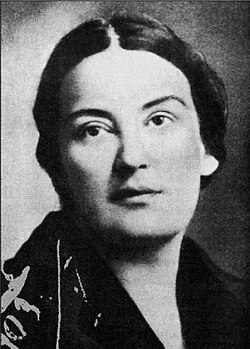
At birth her name was Elizaveta Yurievna Pilenko, and her family owned an estate in southern Russia. At the age of 14, following the death of her father, she moved with her mother to St. Petersburg, and she became acquainted with the writers working there at the time, in what has been called Russia’s Silver Age. She was drawn to left-leaning politics and art, and spent time at the renowned Stray Dog cafe. She developed friendships with Aleksandr Blok, a Russian symbolist, and Boris Pasternak, with whom she continued to correspond all her life.
 |
|
Maria Skobtsova.
|
At 18, she married a Bolshevik named Dmitry Kuzmin-Karavaev, and their relationship was a disaster. Some of her biographers say that she married him out of pity. He was an alcoholic, and adrift. Their marriage ended a few years later when Dmitry became a Roman Catholic priest, and their daughter Gaiana was born. At the same time, Elizaveta applied for admission to the all-male Saint Petersburg Theological Academy. The rector admitted her.
She was in St. Petersburg in 1917 when Russia’s provisional government was overthrown by the Bolsheviks. It was a tumultuous time, and in the midst of rumors that she and other people from her political party planned to assassinate Leon Trotsky, she returned home with her daughter. A year later she was elected deputy mayor there. But this was clearly a losing proposition, with the White Army (the aristocrats) on one side and the Bolsheviks (the Red Army) on the other.
The White Army put her on trial, accusing her of being a Bolshevik. But the judge in the case was a former teacher of hers, Daniel Skobtsov. The two fell in love. He acquitted her. They married, and in the chaos engulfing their society, they fled like so many others.
In the years after this, the family lived as refugees, following the route of many displaced Russians from Tbilisi, Georgia, where her second child, Yuri, was born; to Istanbul, Turkey; to Yugoslavia, where Elizaveta’s third child, Anastasia, was born; and finally to Paris, where the family tried to survive amidst a tidal wave of desperate Russian emigres.
At first, the family did anything it could. Elizaveta made dolls and silk scarves. Daniel worked as a teacher. Meanwhile, Elizaveta still tried to write, still found herself drawn to theological movements and still found her spirit moving her toward serving the misery she saw around her. Then in 1926, Anastasia, five years old, died of meningitis.
 |
|
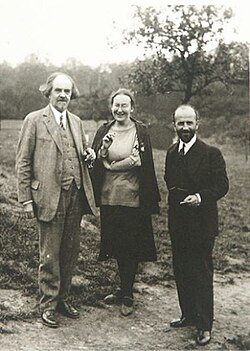
Maria Skobtsova with Nikolai Berdyaev and Stefan Tsankov in 1930.
|
Everything started to fall apart: her marriage, her family, her entire life. Gaiana was sent to boarding school in Belgium, Yuri moved in with Daniel, and Elizaveta took the first steps toward the defining work of her life. She moved alone to central Paris to become a nun and to be close to those who were suffering the most.
In the late 1920s and early 1930s, she began to develop houses of hospitality, which she said would be “half-monastic and half-fraternal.” In 1932, she secured an ecclesiastical divorce, took the name “Maria” and started her “monasticism in the world.” The idea was to feed people, not only physically, but also spiritually and intellectually.
She rented a house in central Paris and opened the door for refugees of any kind. She hosted salons for theological and intellectual debate. Over the next several years, she opened multiple houses of hospitality and founded an organization called Orthodox Action.
In 1940 France fell to the Nazis. The houses that Orthodox Action ran turned to helping Jewish refugees. Skobtsova helped organize sanitation workers to smuggle Jewish children out of the city in garbage cans. By now, Yuri was working with her, as was her good friend Father Dmitri Klepenin.
Klepenin began to provide fake baptismal certificates to Jews, and in 1943, a letter about providing these certificates was found by the Gestapo in Yuri’s pocket. He was arrested; the next day Father Dmitri was arrested; and the next day, February 10, 1943, Mother Maria was arrested.
Dmitri and Yuri both died at the Dora concentration camp of illnesses contracted there. Residents of the Ravensbrück camp, where Mother Maria was sent, say that she continued to live in the same way as she had lived in Paris: helping where she could, using whatever resources she could. She held conversations about poetry and theology among residents that some later described as life-saving. Then on March 30, 1945, she changed places with another woman and sent herself to the gas chamber.
 |
|
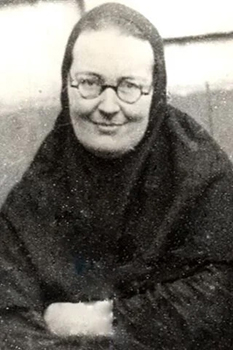
Maria Skobtsova.
|
The lived theology of Maria Skobtsova is a theology of the second commandment. In an essay called “The Second Gospel Commandment,” Skobtsova writes that the second commandment is not about thinking kind thoughts about our neighbor or even doing nice things for our neighbor. It is a far more radical act than that. We turn toward the spiritual life of another person and recognize that in that person “one encounters the terrible, inspiring mystery … [of] … the authentic image of God, the very incarnate icon of God in the world, a glimmer of the mystery of the Incarnation.”
The more suffering our neighbor is in, the more we understand the work of Christ in and through that person. We do not aid a suffering person because we imagine some kind of reward for ourselves. We also don’t do it out of a sense of duty or piety. In love, none of these things matter. Instead we are “aflame with love.” Modeled after the incarnation, our love must be the “most concrete, practical love.” But even through these material acts of support, we also know that a person has a “spirit-bearing nature,” and so we allow that other person to teach us what it means to love God and to love our neighbor.
In Skobtsova’s understanding, Paul’s baseline that “love does no wrong to a neighbor” (Romans 13:11) is far too low. Any follower of Christ goes much farther than that. The second commandment is a call to love through accompaniment and to love through sacrifice. This is how we learn to love God with our whole heart.
Weekly Prayer
Teresa of Avila (1515-1582)
Christ has no body but yours,
No hands, no feet on earth but yours,
Yours are the eyes with which he looks
Compassion on this world,
Yours are the feet with which he walks to do good,
Yours are the hands, with which he blesses all the world.
Yours are the hands, yours are the feet,
Yours are the eyes, you are his body.
Christ has no body now but yours,
No hands, no feet on earth but yours,
Yours are the eyes with which he looks
compassion on this world.
Christ has no body now on earth but yours.Born in Spain, Teresa (1515–1582) entered a Carmelite convent when she was eighteen, and later earned a reputation as a mystic, reformer, and writer who experienced divine visions. She founded a convent, and wrote the book The Way of Perfection for her nuns. Other important books by her include her Autobiography and The Interior Castle.
Amy Frykholm: amy@journeywithjesus.net
Image credits: (1, 2) Wikipedia.org; and (3) Refugee House Calais.