From Our Archives
For earlier essays on this week's RCL texts, see Dan Clendenin, Doubting Thomas (2023); Debie Thomas, Unless I See (2020); and Dan Clendenin, "A Special Army of Piety" (2017).
This Week's Essay
By Amy Frykholm, who writes the lectionary essay every week for JWJ.
Psalm 16:11: “You show me the path of life.”
For Sunday April 12, 2026
Lectionary Readings (Revised Common Lectionary, Year A)
Psalm 16
1 Peter 1:3–9
John 20:19–31
The spring that I was 21, I spent Holy Week at a place in southern Ohio called Grailville. Grailville was a women’s collective organic farm and spiritual retreat center that was founded by Catholic lay women as part of a global organization called The Grail. A close friend of mine had spent the semester there on an arts and spirituality fellowship, so I drove out from Minnesota to join her.
Holy Week at Grailville was a big deal, and every day of the week brought something beautiful. There were art projects, gardening work, and nightly liturgies. I was invited to participate, and on Holy Saturday, I was assigned the task of making a “resurrection garden.” I didn’t know what a resurrection garden was, where I should put it, what should go in it, or how big it should be, and I was lacking clear instructions.
But there were two larger problems. One was that I lacked artistic confidence. I said yes to the assignment, but I knew I was no gardener and no artist. I was definitely pretending to be someone I was not. The other was that my belief in the whole Christian project was wavering. As much as I was enjoying the pageantry of Holy Week, I didn’t know where I stood on some of the more momentous propositions of Christianity. One of the women in my friend’s house said at lunch, “I look at you and I don’t see resurrection garden.” How did she know? I’d spent so much of my life performing my religiosity that it felt strange to be called out.
 |
|
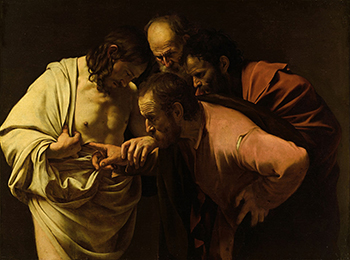
Caravaggio, The Incredulity of Saint Thomas (1603).
|
I honestly don’t remember what I came up with for the resurrection garden. Probably some rocks, dirt, and a few flowers. Pam was more or less right. I didn’t have resurrection garden in me. But I do remember that night, sitting at the Easter Vigil fire circle. One of the women exhorted us, “Ask yourself: Do you believe in the resurrection? Do you really believe?” I sat very still surrounded by all these strangers, and I thought, “No, I don’t think I do.”
Easter Sunday liturgy was gorgeous. Hand-dyed banners for Earth, Fire, Air, and Water were carried up from the river to the outdoor worship space; robust singing broke out. The service ended with dancing. It felt strange to hold all of that beauty on the one hand, and my newly acknowledged lack of belief on the other. It was a relief to set down my belief, honestly. I’d been holding it tightly for a long time. I felt like I just opened my hand and watched it fly off. But now that it was gone, what was left in its place? I had a quiet, empty feeling that stayed with me.
A decade later, I was back in church. I hadn’t resolved the question of belief, but I had basically decided to give up on it. I wanted to stop bullying myself into trying to believe or not believe and just enjoy the power of the liturgy, the potency of community, and the depth of the stories. It must have been the second Sunday in Easter, because the Gospel was about Thomas.
The first thing that struck me on this Eastertide was that there was a second Sunday to Easter. In the churches I had grown up in, we spent one day on the resurrection and 364 days on belief. But now I had 50 whole days to try to make any sense that I could of the resurrection. And a whole variety of stories to help me. That was longer than Lent!
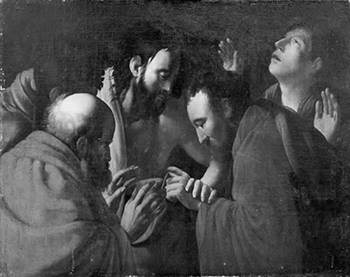 |
|
Anonymous, Doubting Thomas (1500).
|
The second thing that struck me wasn’t whether Thomas should have or could have or would have had doubts. That part now seemed obvious to me. Jesus appears to the disciples in their locked room, and he shows them his wounds. That was the part that shocked me: Jesus — resurrected — still had wounds. Wait, I thought. This is the resurrected body. The resurrected body is still a wounded body. How had I never noticed this before? Did the wounds still hurt? Was there scar tissue? Scabs?
There’s a painting by the Italian Renaissance artist Caravaggio in which he depicts Thomas actually putting a finger into Christ’s wound. Thomas’ fingernails are dirty; his cloak is torn. The expression on his face is intent. Others crowd around. The intimacy and the graphic nature of it make me flinch, but Jesus’ face is calm, even tender, as Thomas’ finger penetrates his skin.
As Debie Thomas writes, the still-scarred body of Jesus says, "I am with you. I am with you where it hurts. I don't float thousands of sanitized feet above reality. Even after death, I dwell in the hot, searing heart of things. Exactly where you dwell.” With this recognition, I felt that the story had more room for me in it. Not just room for belief or disbelief, as so movingly depicted by Thomas. But also room for my wounds. The story opened up its healing power. The phrase I had heard so often but that had rarely made any sense, “By his wounds we are healed,” came into a new and paradoxical light. We are healed by that which has not yet healed. And even after healing, our bodies still tell the story.
It reminded me of an image from Julian of Norwich. In her visions, Jesus is hanging on the cross, and he looks down at his side, and then invites her to go through the wound and inside his body. There she finds “a fair, delightful place, and a place large enough for all humankind that will be saved to rest in peace and in love.” Like healing, salvation is a word that means “whole” and “complete.” The mystery is that as we enter the wounded place, we are made whole.
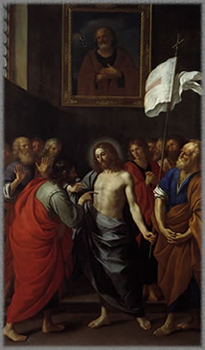 |
|
Bartolomeo Gennari, Doubting Saint Thomas (1644).
|
But still I remain uncomfortable with Jesus’ words, “Have you believed because you have seen me? Blessed are those who have not seen and yet have come to believe” (John 20:29). A few weeks ago, on his Substack, poet and theologian Pádraig Ó Tuama wrote, “I have studied too much theology to be comfortable with any easy language about belief. I believe people’s belief, but I am also sometimes confused by it. I find belief — religious belief, I mean — to sometimes be beyond me. It’s like asking me my opinion about imaginary numbers: they’re useful in some circumstances, but unprovable.”
But Ó Tuama doesn’t dismiss or disparage belief. “Many people I admire, respect, love, and trust are people of deep beliefs. I admire it. Amidst their beliefs, I do not place myself in comparison. I, too, have a relationship with belief. Mostly, I feel like I’m in the room next door. Familiar. A neighbour. I call in … often. But distinct. I am not alone as a neighbour of God, near the household, but not of it. I think there are billions of us abutters.”
“I, too, have a relationship with belief.” I love this phrase, and I’ve taken it on as my own. What’s my relationship with belief like? Well, we talk. There’s an ongoing and still open conversation. Belief hasn’t moved out from its room next door. Some days the conversation goes better than on other days. But, yes, I remain mostly baffled by it. Belief adjacent, as Ó Tuama says. An abutter.
But belief also no longer seems like a yes or no question. Beyond yes or no is that space that Julian envisioned, wide open, a fair delightful place where the invitation is more powerful than my answers.
Weekly Prayer
Henry Vaughan (1621–1695)
Unfold! Unfold! Take in His light,
Who makes thy cares more short than night.
The joys which with His day-star rise
He deals to all but drowsy eyes;
And, what the men of this world miss
Some drops and dews of future bliss.Hark! How His winds have chang’d their note!
And with warm whispers call thee out;
The frosts are past, the storms are gone,
And backward life at last comes on.
The lofty groves in express joys
Reply unto the turtle’s voice;
And here in dust and dirt, O here
The lilies of His love appear!Henry Vaughan (1621–1695), a Welsh poet and physician, was born in Llansanffraid, where he lived for most of his life and was eventually buried. Vaughan studied at Oxford, but never took a degree, and then moved to London where he studied law for two years. He underwent a spiritual awakening that he credited to the poetry of “the blessed man, Mr. George Herbert.” Vaughan was married twice and fathered eight children.
Amy Frykholm: amy@journeywithjesus.net
Image credits: (1) Wikipedia.org; (2) Wikimedia.org; and (3) Wikimedia.org.