
From Our Archives
For earlier essays on this week's RCL texts, see Dan Clendenin, The Church as Noah’s Ark (2023); Debie Thomas, Love and Obedience (2020); and Dan Clendenin, Paul at Athens (2011).
This Week's Essay
By Amy Frykholm, who writes the lectionary essay every week for JWJ.
John 14:20: “On that day you will know that I am in my Father, and you in me, and I in you.”
For Sunday May 10, 2026
Lectionary Readings (Revised Common Lectionary, Year A)
Psalm 66:8–20
1 Peter 3:13–22
John 14:15–21
When Thecla, a saint in early church history, first heard Paul speak, she was entranced. She leaned out her window and “listened day and night,” says The Acts of Paul and Thecla. For the people around her, Paul was a “strange man” with “deceptive and cunning words” who was convincing women to do terrible things like refuse to get married. But what Thecla heard was something different. She heard a call for her own life.
Because of Paul’s teaching, Thecla decided that she was not going to marry her betrothed, Thamyris. Instead she was going to seek an opportunity to be baptized and then teach and preach like Paul. This decision caused a catastrophe in her family. Not only did Thamyris seek to have both Paul and Thecla imprisoned, Thecla’s own mother asked the governor to “Burn the lawless one! Burn the one who refuses to be a bride in the middle of the theater so that all the women taught by this man will be afraid.”
The Acts of Paul and Thecla is an adventure story that was written in the second century, or perhaps as early as 70 CE. It was a widely popular story in early Christian movements, even popular during the late second century when Tertullian condemned it and later when fourth to sixth century church authorities tried to eradicate texts that demonstrated women’s power and authority.
After Thecla miraculously survives the burning, The Acts goes on to describe the numerous ways that people tried to kill both her and the spirit of freedom that Paul’s teaching had brought forth in her. But Thecla will not be denied. At the climax of the story, after she’s been thrown to wild beasts and assumes that she will die, she decides to baptize herself, since Paul has so far failed to baptize her. “In the name of Jesus Christ I baptize myself on the last day!”
 |
|
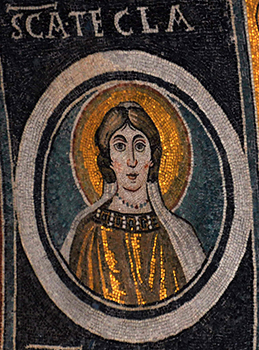
The Apse Mosaics in the Euphrasian Basilica, Saint Thecla, 6th c.
|
The story ends in a tender way. After all that she’s been through, Thecla decides to return home and seek reconciliation with her mother. She leaves with Paul’s blessing. “Go and teach the word of God,” Paul says. Thamyris has by now died. Thecla is now the teacher that she had dreamed of being. She stands before her mother and tries to address her mother’s fears. “Mother, can you believe that the Lord lives in heaven? … Look, I am now standing before you.” The text gives no record of her mother’s response.
Today we spend a great deal of time on arguments about Paul, about his views on slavery, bodies, sex, women, and leadership. In The Acts of Paul and Thecla, we have a fascinating witness account. Among other things, we have a physical description of Paul. He was “a man small in stature, with a bald head and crooked legs, healthy, with knitted eyebrows, a long nose, and full of kindness.” At times he seems to have the face of a man, and at other times “the face of an angel.” Think how rare this is in early Christian texts. We don’t know what Jesus, Peter, or Mary Magdalene looked like, but here is such a vivid description of Paul, you can suddenly imagine him living next door.
And there is no doubt that what Thecla heard in his message was a powerful force of liberation. And what exactly was she liberated from? “I am the slave of the living God,” she says. “This one alone is the limit of salvation and the foundation of life through the ages. For he is a refuge for those in a storm, freedom for the oppressed, for the despairing a shelter.” She was liberated from the limits imposed on her by her particular time and place, by those who said that because she was a woman, she could not follow the path she had chosen.
 |
|
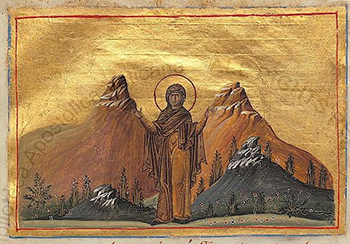
Menologion of Basil II, Saint Thecla, 985.
|
As I consider The Acts of Paul and Thecla and return to The Acts of the Apostles, I now see new things highlighted for me in Paul’s sermon to the Athenians. I try to listen through Thecla’s ears. Like Thecla, Paul proclaims a God who is not limited by human structures or imaginations, who “gives to all mortals life and breath and all things” (Acts 17:24). Paul also notes how God gives each human being a time and a place. We are each of us born to a particular people, to a particular geography, and to a particular time. Each of these circumscribes us, but also makes our living possible. What is the purpose of this context? To lead people, no matter where they were born and who they were born to, to “search for God and perhaps fumble about” to find the God who “is not far from each one of us” (Acts 17:27).
Paul’s endorsement of the spiritual journey is fascinatingly illustrated by The Acts of Paul and Thecla, in which a woman searches for God, feels her way toward God, leaves behind a world of wealth and worldly security so that she can conduct that search, and ultimately discovers God’s presence within her. I am reminded of philosopher and theologian Ramon Pannikar’s words, “Each being is a christophany, a manifestation of the christic adventure of the whole of reality on its way to the infinite mystery.”
We are each particular, but we are also all children of God. We all “live and move and have our being” in a God that transcends time and place, transcends human laws and structures, transcends what we tell each other about who can be in the world.
I wonder what it would have been like to have The Acts of Paul and Thecla in our canon, what it would have been like to grow up with this story as a part of the scriptures which were so carefully read and pored over by the people around me.
 |
|
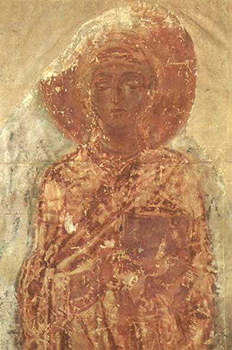
Savior Cathedral of Chernihiv, Ukraine, Saint Thecla, 1050.
|
Would Thecla’s message of profound freedom have gotten through to us? Would we have been able to use this text to grant each other the freedom that we so often withheld? Would we have been encouraged to listen to our own lives for the call that was inside us — to listen “day and night” as Thecla did?
Recently, Meggan Waterson has written about The Acts of Paul and Thecla in a book called The Woman Who Baptized Herself. A few women in my community gathered to read this book together. At the end of our conversation, one woman told us her story. She grew up in a Baptist church and was home-schooled. When she was eighteen, her parents arranged her marriage to a man from the same church, the son of the pastor. They married. By the age of twenty-two, she had three children.
“I understand Thecla,” she told us. “I was Thecla.” Her culture had already decided who she would be, how she would live, and what she was required to consent to. When she decided to leave the confines of this upbringing, perhaps she wasn’t condemned to be burned, but she paid a very high price. Ostracized, she talked about having to turn to a very deep understanding of the God that was within her, that valued her freedom and wanted her thriving. She had to act to save her own life.
The story of Thecla is still very much alive in our communities and in our churches. We still confine each other and ourselves to cages of our making. Yet there is still, in the message of Paul, an opportunity for a different kind of Christianity — a Christianity rooted in love and liberation.
Weekly Prayer
Hildegard of Bingen (1098–1179)
Holy Spirit, bestowing life unto life,
moving in All.
You are the root of all creatures,
washing away all impurity,
scouring guilt,
and anointing wounds.
Thus you are luminous and praiseworthy, Life,
awakening, and re-awakening all that is.Hildegard of Bingen (1098–1179) lived a life that was remarkably long and incredibly productive. Carmen Butcher has described Hildegard as an "Über-multitasking Frau" and authentic "polymath." The Benedictine abbess founded two convents, conducted four preaching tours, penned at least 400 letters, wrote music and a morality play, supervised illuminated manuscripts, cared for her fellow sisters, and wrote three major theological tomes based upon her famous visions.
Amy Frykholm: amy@journeywithjesus.net
Image credits: (1) A Guide to Christian Iconography; (2) Wikipedia.org; and (3) Wikimedia.org.





.jpg)
