From Our Archives
For earlier essays on this week's RCL texts, see Dan Clendenin, Taken Up to Heaven: The Ascension of Jesus (2023); Debie Thomas, That They May Be One (2020); and Dan Clendenin, Positively Maladjusted (2017) and Judas and Matthias: Divine Mystery and Personal Destiny (2011).
This Week's Essay
By Amy Frykholm, who writes the lectionary essay every week for JWJ.
1 Peter 5:7: “Cast all your anxiety on him, because he cares for you.”
For Sunday May 17, 2026
Lectionary Readings (Revised Common Lectionary, Year A)
Psalm 68:1–10, 32–25
1 Peter 4:12–14, 5:6–11
John 17:1–11
Lately I’ve been tracking the demise of yet another American apocalyptic religious group whose end comes in a blaze of scandal, accusation, fraud, and abuse. The story is so common in American religious life that it’s easy to overlook, and I feel a little sheepish highlighting this group when there are so many others that we could point to.
The particular group that I’ve recently studied is the International House of Prayer — Kansas City. The leader of the now almost-defunct IHOPKC was Mike Bickle, and two and a half years after being accused of the sexual abuse of at least 17 women (including minors) over his 50 years of ministry, he has recently attempted to stage a ministry comeback.
Grandview Fellowship, the church of Bickle supporters that formed in the wake of the demise of IHOPKC, recently announced a week of “prayer and fasting” for the “heaven-ordained ministry” of Bickle. If you don’t track things like this, I am sure this call was not even a blip on your radar screen, but for the survivors of IHOPKC, it was a moment they had been bracing themselves for.
The International House of Prayer was formed in 1999, and its most famous element was the Global Prayer Room, where worship teams prayed for 24 hours a day seven days a week every day of the year. Their efforts — and just think for a moment how considerable these efforts would have to be — were fueled by apocalyptic teachings and preaching. Their work in the prayer room was to pray the world to its end. For this purpose, they needed thousands of “interns” who committed at least 24 hours a week to the prayer room and another 24 in service to the community. It was an all-consuming endeavor for the thousands who followed Bickle over the decades.
 |
|
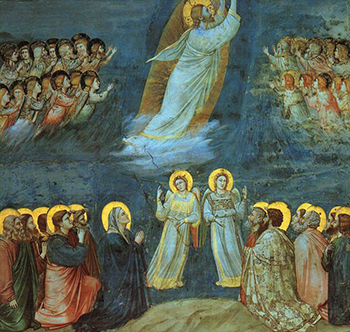
Giotto, L’Ascensione (1305).
|
Bickle formed what he called a “prophetic history” in which he attempted to document how his predictions of the future were coming true and how they marked a path to the end of the world and Jesus’ Second Coming. Bickle continues to see himself, as the prayer and fasting week demonstrates, at the center of God’s plans for the future. No fall from grace can change that, and in fact, his supporters say, it’s just more evidence of the “dramatic assault against the prayer movement and specifically Mike Bickle.”
I don’t know whether to laugh or cry when I think about how this week’s lectionary text is directly implicated in the unfolding of the story of the International House of Prayer — and that of so many other apocalyptic movements. In Acts 1:6, the disciples raise a question. "Lord, is this the time when you will restore the kingdom to Israel?” They want some answers about the immediate future. They are still imagining that Jesus is a king for this moment.
The disciples have been through Jesus’ death and resurrection. They have also just been, according to Luke, through a 40-day tutorial on the kingdom of heaven with the resurrected Jesus. But they still have concerns — about Rome, about the future of Israel, about the oppression of the people, and about what Jesus’ ministry meant. Something is still missing: a map, a plan, an outline, a detailed account of how the kingdom will be restored to Israel. If that’s not what this is about, then why did they bother?
We can appreciate how human this is: how much all of us worry about the future and probably overestimate the role we play, how we are always trying to assess our own political moment and make it more grandiose than it is. Luke tracks self-aggrandizement throughout his gospel account, and now it reappears in Acts. But our political leaders of this moment do it too. Not a few have attempted to evoke the imagery and iconography of holy wars and end-times visions to rally the American public to a war about which they are deeply skeptical.
And Jesus’ answer, in this moment immediately before the Ascension, couldn’t be more cautionary. “It is not for you to know the times or periods that the Father has set by his own authority” (Acts 1:7). I hear Jesus saying to the disciples, “I’m keeping some colossal secret from you, but you can’t know this. You can’t know this because your perspective is too small.” When I think about how our cosmic understanding of both time and space has transformed and drastically expanded since Jesus spoke these words, I feel even more how infinitesimal our human experience is.
 |
|
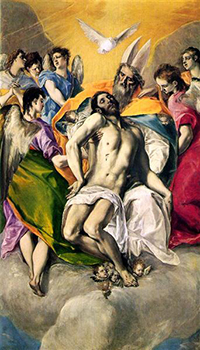
El Greco, The Ascension of Jesus (1577).
|
But couldn’t we just try? There have been many attempts over the centuries to grapple with the uncertainties inherent in a religion as linear as Christianity. I think of the famous typology of eras determined by Joachim de Fiore in the 12th century and the eras declared by dispensational premillennialism beginning in the 19th century that have influenced so many in our own time.
I think of the now dusty prophetic declarations of Christopher Columbus and Isaac Newton. And I think of Mike Bickle — not because he is great, but because he is small. He has, like so many others, imagined his own greatness. And I think of the thousands and thousands, perhaps millions, of people who have been traumatized by these kinds of claims and their consequences.
Jesus does offer an alternative to the plan-starved disciples: the humble submission to not knowing, the position of receptivity to the Holy Spirit, and finally, the work of being witnesses. But what does it mean to be a witness? Certainly the people in the prayer room at IHOPKC and especially their leaders would have called themselves witnesses. They also would have asserted their humility and their receptivity. Our religious vocabulary becomes convoluted and gets used for many different purposes.
In the wake of the demise of IHOPKC and the recognition that the organization had left thousands of traumatized people spiritually bereft, a small group formed that has called itself “The Care Group.” They’ve seen their task as two-fold. They’ve explored what lawsuits can be filed on behalf of victims, and they see their primary task to care for people who have been traumatized by the religious culture of IHOPKC and by the abusive practices of its leaders, not only of Mike Bickle. Katie Fetzer, a victim advocate and one of the founders of the group, said on the podcast Heaven Bent, “The story of [every] individual is precious, and it is also a confirmation of a lot of other people’s stories … The entire congregation has been victimized through coercive manipulation and control. The whole community is responding in trauma.”
 |
|
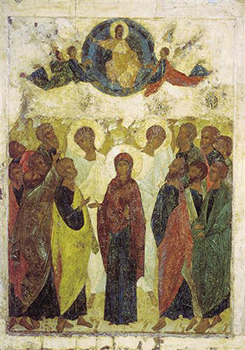
Andrei Rublev, The Ascension of Jesus (1408).
|
Podcaster Tara Jean Stevens asked Fetzer what she would want to say to victims if she could speak to them directly, and her answer seems to me to be an answer, at least in part, to the question: what does it mean to be a witness? To a victim, she would say,
“The first thing is that you matter and you have value, and what happened to you was 100 percent wrong … You may not even call yourself a victim. You may not call yourself a survivor. You are just someone who's sitting here feeling like you’re in a pile of ashes and you don’t know why. We’re here for you. And the simplicity of the gospel is this: Jesus came for the brokenhearted.”
To witness is to hold the story. The disciples are advised — we might even say admonished — to set aside any grandiose vision of their own role and to go out on the streets and into the lives of ordinary people and hold the story: life, death, resurrection. This story isn’t only for Jerusalem or Judea or Samaria. Somehow it is for the whole earth, and for each person’s own story individually.
We can never say this in a triumphalist way or with an assumption that we already know someone else’s story, but only with the utmost care and respect for the dignity of each human being. Reading Acts 6, we keep making the disciples’s mistake over and over again. We don’t matter because we’re playing a role in some cosmic drama. We matter because we are loved.
Weekly Prayer
Malcolm Guite (b. 1957)
We saw his light break through the cloud of glory
Whilst we were rooted still in time and place
As earth became a part of Heaven’s story
And heaven opened to his human face.
We saw him go and yet we were not parted
He took us with him to the heart of things
The heart that broke for all the broken-hearted
Is whole and Heaven-centred now, and sings,
Sings in the strength that rises out of weakness,
Sings through the clouds that veil him from our sight,
Whilst we our selves become his clouds of witness
And sing the waning darkness into light,
His light in us, and ours in him concealed,
Which all creation waits to see revealed.Ayodeji Malcolm Guite (b.1957) is an English poet, singer-songwriter, Anglican priest, and academic. Born in Nigeria to British expatriate parents, Guite earned degrees from Cambridge and Durham universities. This poem is from Sounding the Seasons: 70 Sonnets for the Christian Year (Canterbury Press, 2012).
Amy Frykholm: amy@journeywithjesus.net