From Our Archives
For earlier essays on this week's RCL texts, see Dan Clendenin, Born From Above (2023); Debie Thomas, Where the Wind Blows (2020); Dan Clendenin, A Jewish Ritual for a Lenten Discipline (2014), The Longest and Hardest Journey (2011), and Abraham in Three Movements (2008).
This Week's Essay
By Amy Frykholm, who writes the lectionary essay every week for JWJ.
John 3:8: “The wind blows where it chooses, and you hear the sound of it, but you do not know where it comes from or where it goes."
For Sunday March 1, 2026
Lectionary Readings (Revised Common Lectionary, Year A)
Psalm 121
Romans 4:1–5, 13–17
John 3:1–17 or Matthew 17:1–9
In a letter in 1819, the English poet John Keats argued against his culture’s prevailing view that the world was a “vale of tears” through which humans had to pass in order to reach heaven’s joys. His view was very different. “Call the world, if you please, a vale of soul-making,” he wrote. Instead of being passive passengers carried through the world by an all-powerful being, we are brought into the world as “sparks of the divinity,” and we are charged with the work of becoming souls. We are given three tools, he says, for this work: our intelligence, our hearts, and the revealed and incarnate world itself. Each individual undergoes a particular set of trials in order to shape their precious life into a soul. “Do you not see how necessary a World of Pains and troubles is to school an Intelligence and make it a soul? A Place where the heart must feel and suffer in a thousand diverse ways!”
The difference between a vale of tears and a vale of soul-making is the willingness to undergo change, to begin the process of transformation. In God’s first words to Abraham in Genesis 12, Abraham (then Abram) is commanded to “go forth” into this vale (12:1). The only thing we know about Abram prior to this astonishing moment of call is that his father had left the land of Ur and had attempted to travel to Canaan. But his family only got as far as Harran and settled there. Abram had lived his entire life in Harran. It was everything that he knew of the world.
Then God called Abram out of this realm of comfort and certainty. The problem is that God did not give Abram anything but the most vague of destinations: “a land I will show you.” This is on one level the promise of a future for Abram’s as-yet unborn descendants. On another level, it is a call out of Abram’s known self — settled in the land where he already lived — into a self he could yet be, the awakened self, the yet-to-be-imagined self.
 |
|
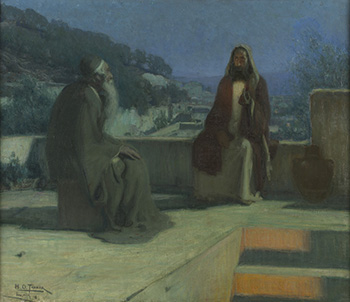
Henry Ossawa Tanner, Nicodemus Visiting Jesus (1899).
|
Who travels without knowing where they are going? Last year I attended a panel at a writing conference with the novelist Joyce Carol Oates. When asked about her writing process, she scoffed at the idea that she might set off writing a novel and not know where it would end up. “Would I leave my house and drive off without knowing where I was going? Of course not!”
But this seems to be exactly what is demanded of Abram: set off and find out later where you are bound. One way to understand this call to depart is to see the tradition’s pull toward soul-making. To make our souls, we must undergo a process, we must be willing to subject ourselves to the uncertainty, pain and trials of the journey and let the journey change us. The land where we end up might not be the same one we embarked toward. As Keats observed many centuries later, the outer journey is also an inner journey.
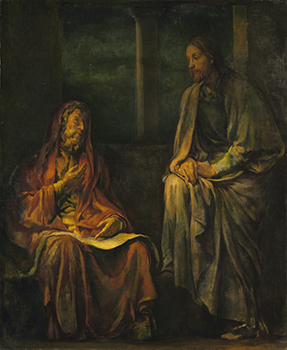
We see some of these elements paralleled in the story of Nicodemus. He comes to Jesus under the cover of night. Commentators have interpreted this detail in different ways. Some have seen the cover of darkness as suggesting that Nicodemus needed to be secretive about his adventure. Perhaps he was coming to Jesus with a great deal of personal risk. But the same metaphor of darkness has been understood to be the condition of a person seeking spiritual enlightenment. We start our journeys in the dark. And maybe both are true: the spiritual journey is, in fact, a risk. We will suffer if we undertake it. We put much at risk.
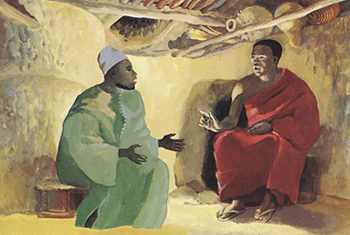
Nicodemus comes to Jesus without even an opening question. He simply confesses his belief that Jesus’s teaching must come from God. Jesus replies, “Very truly, I tell you, no one can see the kingdom of God without being born from above” (John 3:3).
 |
|
Jesus Mafa, Nicodemus (1973).
|
What could be stranger? I appreciate Nicodemus’s willingness to say as much: “How can these things be?” Birth is something he thinks he understands, and it doesn’t happen “from above,” but from below. He is being asked to enter into a paradigm shift that is so complete it will upend everything he knows. When Nicodemus expresses astonishment, Jesus complicates the point even more. “Do not be astonished that I said to you, ‘You must be born from above.’ The wind blows where it chooses, and you hear the sound of it, but you do not know where it comes from or where it goes. So it is with everyone who is born of the Spirit” (John 3:7-8). In other words, in this call, even more extreme than the call of Abraham, there is truly no destination promised.
In this passage, Jesus is no practical guide, no rational dispenser of wisdom. He is no guarantor of spiritual safety. He outlines a path of self-transformation full of risk whose only destination is love. Habits of the self, certainties clung to for generations, ways of seeing that everyone takes for granted are tossed out. What is offered is a “vale of soul-making,” a path on which the old skins are shed.
It is ironic that generations of Christians have turned to this passage to give themselves a sense of ultimate certainty. If you take John 3:16 out of context and squint at it through the lens of American individualism, you can almost see why this verse might seem to promise that you’ll never have to experience uncertainty. Believe. Check. Love. Check. Eternal life. Check.
But if you put that single verse in the context of the passage as a whole, it suddenly seems full of uncertainty. We have the mystery of being “born from above” followed by the strangeness of the Spirit blowing through our lives “where it chooses.”
 |
|
John La Farge, Visit of Nicodemus to Christ (1880).
|
Just as a thought experiment, I wonder what our religious culture would be like if we had chosen, instead of John 3:16, John 3:8: “The wind blows where it chooses . . . so it is with everyone born of the Spirit.” What if this was our national religious motto, if this was what appeared on homemade placards at baseball games? What if this was the one thing everyone knew about Christianity? That Christians served a windy God. How many people would sign up for that program?
There was a time in my life when I did sign up for the John 3:16 program. They said, “you must be born again,” and I said, “Okay, let me be born again.” But then like Abraham, I was called to go forth into my own particular and strange vale of soul-making. I gradually understood, at times to my dismay and at times to my utter delight, that this wasn’t a once-and-for-all proposition. I was going to have to shed many skins; there are a lot of selves to be undone in the vale of soul-making. I was going to have to be blown around in many different ways to become who I most truly am. To me that is the promise in this story: that we are asked to consent to a process of transformation and walk a road through life in which we are not invited into a ready-made program of salvation, but we are, in what Keats calls a “system of Spirit-creation,” always becoming.
Weekly Prayer
Psalm 121
I lift up my eyes to the hills-- from where will my help come?
My help comes from the LORD, who made heaven and earth.
He will not let your foot be moved; he who keeps you will not slumber.
He who keeps Israel will neither slumber nor sleep.
The LORD is your keeper; the LORD is your shade at your right hand.
The sun shall not strike you by day nor the moon by night.
The LORD will keep you from all evil; he will keep your life.
The LORD will keep your going out and your coming in from this time on and forevermore.
Amy Frykholm: amy@journeywithjesus.net
Image credits: (1) Pennsylvania Academy of the Fine Arts; (2) Vanderbilt University Divinity Library; and (3) Smithsonian American Art Museum.