From Our Archives
For earlier essays on this week's RCL texts for both The Liturgy of the Palms and the Liturgy of the Passion, see Dan Clendenin, Meditation on a Show Trial (2023); Debie Thomas, A Crucified God (2020), and The Clown King (2015); Sara Miles, Happy Holy Week (2014) and Stop Pretending: From Lenten Ash to Easter Light (2011).
This Week's Essay
By Amy Frykholm, who writes the lectionary essay every week for JWJ.
Psalm 118:2: “Let Israel say, ‘God's steadfast love endures forever.’”
Years ago, a friend took me to see an art exhibit featuring the work of Sister Corita Kent. If you live in the Boston area, you probably know Kent’s work by the “Rainbow Swash” water tower in Dorchester. But while I had seen the “Love” postage stamp that she designed, I had never heard of her. The exhibit was a life-changing experience.
Often referred to by her first name, Corita (“little heart” in Latin) was a religious sister and an artist who taught for many years at Immaculate Heart College in Hollywood. Dubbed a “joyous revolutionary,” she was an artist in the Andy Warhol school of pop and folk art, and she was inspired by everyday life — by billboards, advertisements, gas stations, supermarkets, and even cracks in the sidewalk.
Two of her artistic endeavors stood out to me that day. One was an artistic exploration of the word wonder in Wonder Bread. Another was her improvisations on a Dole advertising campaign in which she asserted that the Virgin Mary was the “juiciest tomato of them all.”
Soon after seeing this exhibit, I bought a book called Learning by Heart, in which a former student of Corita’s collaborated with her to articulate her particular vision for art. It is peppered with wonderful sayings like, “Life is an opportunity to speak out before all the answers are in” and “The commonplace is not worthless, there is simply lots of it.”
 |
|
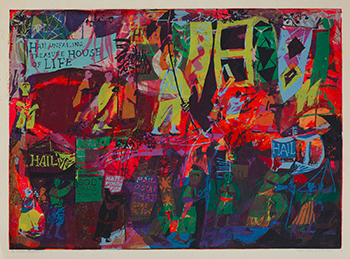
Corita Kent, All the Nations Shall Come (1955).
|
In the book, Corita writes about her reimagining of celebrations on her campus. At Immaculate Heart, the school had a tradition of celebrating Mary Day. When Corita entered the picture, the traditional celebration included a solemn procession with students dressed in black caps and gowns. The seniors carried white lilies and placed them in a vase by a statue of Mary. It was, Corita writes, “a sincere, respectful, and earnest, if parochial, ceremony.”
But when Corita got hold of the planning, everything changed. Paintings mounted on sticks, original artwork on every surface, puppets, music, dance — the celebration was transformed to meet the moment. Exuberance, life, and energy poured into and over the traditional somber form. The revived celebration “grew out of a desire to make Mary more relevant to our time,” Corita wrote. “We wanted to enliven a day of the shrunken and habitual to include many of these rediscovered elements.”
This is how I have started to think about Palm Sunday. In my experience, Palm Sunday has indeed become “shrunken and habitual.” Last year when we marched around the sanctuary with our fronds singing “Glory, Laud, Honor,” I felt embarrassed and even a little pathetic for my own lack of energy and feeling.
My ideas for reimagining a celebration of Palm Sunday started as seeds planted by Corita, but they grew, as Corita knew they should, using the limits, specificity, and delights of my own time and place. The first thing I thought of was the donkey, or the burro as we call it here.
 |
|
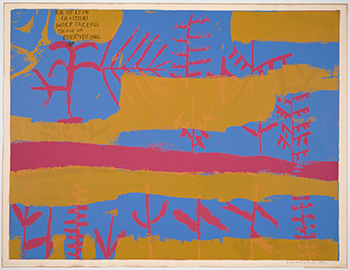
Corita Kent, Be of Love #4 (1963).
|
I live in a historic mining community that reveres the burro for its tenacity, its smallness, and its sure-footed ability to maneuver difficult terrain. Many people I know own burros and hang out with them as if they are best friends. There is even a local summertime race, featuring runners and their burros, that covers 21 rugged miles and crests at over 13,000 feet. No one can finish this race without a close relationship of trust with their animal-companion.
So last year, my church-supply palm frond still in my hand, I thought, “Maybe Palm Sunday could be a celebration of the burro. I wonder if anyone would let us have a parade, even around the neighborhood, with their burro?”
Our pastor was on board with the idea, and when I worried out loud about creating more work, she said, “Don’t make more work, make more play!” We decided this year to have a “make a mess, Palm Sunday prep” the night before Palm Sunday. We’ll order pizza and get out the markers and crayons, blow up pictures of donkeys and Jesus for people to color. We’ll make posters and banners. Following Corita, we’ve identified a color for our celebration: purple, and themes: “In the Name of Love” and “In the Name of Peace.”
I recently read about an odd tradition that appears to have developed in 15th-century England. On Palm Sunday, pax cakes were distributed in parishes. There are conflicting descriptions of whether a pax cake was something like a pancake, a shortbread cookie, or a bun. But traditionally, it was stamped with a lamb and a flag to represent peace. It might even have been used to mediate conflict between neighbors, turning Palm Sunday into a kind of reconciliation day in preparation for Holy Week. In some places, parish priests were said to distribute these cakes to parishioners while saying, “God and good neighborhood.” An odd combination of words, at least to my ears.
 |
|
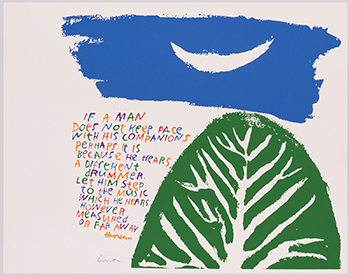
Corita Kent, Thoreau (1971).
|
But I started to think about the neighborhood where my church is located. This year we were engaged a bit with our neighbors about the effects of a six-day-a-week food operation that we run out of the church. Neighbors spoke about garbage that sometimes ends up in their yards, or about people occasionally wandering through their property. We understood that we rely on our neighbors to keep this operation going. We rely on their good will and their understanding. We rely on their willingness to close the street once a month for a huge food pantry.
What if we used Palm Sunday to reach out to them? We could make pax cakes (maybe stamped or frosted with the word pax) and distribute them to our neighbors in packages with purple ribbon and thank them for being such good neighbors. Palm Sunday could be an opportunity to demonstrate our desire to be in our neighborhood in the name of love and shared goodwill.
I’m writing all this before we’ve tried any of it. It could blizzard on Palm Sunday, and there could be no burro and no parade. The pax cakes could be a total flop. Maybe no one will show up to decorate posters and make purple tissue paper flowers. Maybe our neighbors will think we’ve gone nuts. Maybe we’ll be too shy to take our celebration to the street. But at least in my perspective, a reimagining of the tradition is underway. I’m no longer griping about Palm Sunday. I’m starting, just a little, to revel in it.
Weekly Prayer
Malcolm Guite (b.1957)
Now to the gate of my Jerusalem,
The seething holy city of my heart,
The saviour comes. But will I welcome him?
Oh crowds of easy feelings make a start;
They raise their hands, get caught up in the singing,
And think the battle won. Too soon they’ll find
The challenge, the reversal he is bringing
Changes their tune. I know what lies behind
The surface flourish that so quickly fades;
Self-interest, and fearful guardedness,
The hardness of the heart, its barricades,
And at the core, the dreadful emptiness
Of a perverted temple. Jesus comeBreak my resistance and make me your home.
Ayodeji Malcolm Guite (b.1957) is an English poet, singer-songwriter, Anglican priest, and academic. Born in Nigeria to British expatriate parents, Guite earned degrees from Cambridge and Durham universities. This poem comes from Poems from Sounding the Seasons (Canterbury Press, 2012), p.2.
Amy Frykholm: amy@journeywithjesus.net
Image credits: (1) Corita Art Center; (2) Corita Art Center; and (3) Corita Art Center.