From Our Archives
For earlier essays on this week's RCL texts, see Michael Fitzpatrick, While We Were Still Sinners (2023); Debie Thomas, The Woman at the Well (2020); Dan Clendenin, The Woman at the Well (2017), If You Hear His Voice (2014), and Living for More Than Bread and Water (2011).
This Week's Essay
By Amy Frykholm, who writes the lectionary essay every week for JWJ.
John 4:14: “The water that I will give will become in them a spring of water gushing up to eternal life.”
For Sunday March 8, 2026
Lectionary Readings (Revised Common Lectionary, Year A)
Exodus 17:–17
Psalm 95
Romans 5:1–11
John 4:5–42
One of my favorite stories in Joy Williams’s book Ninety-Nine Stories of God is only a few lines long. God was drinking water out of a glass. The water tasted terrible. So God went to the engineers who had built the pipes through which the water flowed.
“What have you done with my water? The Lord asked. My living water....”
“Oh, they said, we thought that was just a metaphor.”
That’s the end of the story, which both makes me want to laugh and raises a lot of question. Is living water a metaphor? Is it a substance? What’s its relationship to actual water?
In this week’s Gospel text, Jesus meets a Samaritan woman at a well and they begin discussing living water (John 4:5–42). Their conversation is the longest that Jesus has with anyone in any of the Gospels. In the previous chapter, when Jesus converses with the Jewish leader Nicodemus, their conversation consists of three brief exchanges. Nicodemus speaks about 50 recorded words, and Jesus gives a short sermon. But in this chapter, the Samaritan woman and Jesus have six substantial exchanges — discussing everything from theological differences between Samaritans and Jews to the woman’s personal history.
That’s not the only contrast with Nicodemus. He is a man; she is a woman. Nicodemus is named; she is not. He is a respected leader; she is a Samaritan with whom Jews have no association. Nicodemus comes to Jesus in the middle of the night; Jesus meets the Samaritan woman at noon. The conversation between Nicodemus and Jesus takes place in Jerusalem, but this conversation with the Samaritan woman takes place on her territory, far from the centers of Jewish power. Perhaps most importantly, when Nicodemus learns about “being born from above,” we know nothing about what he does next. But when the Samaritan woman learns about living water, she goes immediately to share this news with her neighbors. It’s a fascinating study in contrasts.
 |
|
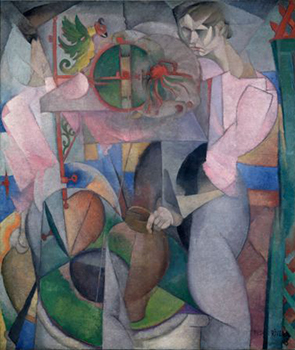
Diego Rivera, The Woman at the Well (1913).
|
Growing up, I was always told the story of the Samaritan woman through the context of sin. She had five marriages after all, and was living with someone who was not her husband. In the community where I grew up, this was so obviously sinful we never bothered to notice that sin is not part of the conversation that Jesus and this woman have. The point of the story, we thought, must be how Jesus offered forgiveness to a woman as sinful as she was and therefore offers forgiveness to us (who weren’t quite as sinful after all). That’s how the story was conveyed to me and, in fact, that’s how the story was told from Tertullian to Calvin and beyond. The focus turned from the theological conversation that the woman and Jesus had to a sexualized portrait of this woman’s life.
What Jesus and the Samaritan woman do talk about is ethnic difference, theological difference, the purpose and meaning of life, the economic and social conditions in which they find themselves, and how to live when your life becomes illuminated by the truth. In fact, in the Eastern Orthodox tradition, the Samaritan woman comes to be called “Photine,” the illuminated one. She is celebrated as a person who, after meeting Jesus and telling her neighbors about her discovery, traveled around the Mediterranean world preaching the gospel. Some parts of the tradition say that she ended up in Rome, preached to Emperor Nero, and died there as a martyr. Lost in the western tradition is the fact that this woman was called the first evangelist and “equal to the apostles.”
I was startled to discover, through reading biblical scholar Caryn Reader’s book The Samaritan Woman’s Story, that this long passage is not about sin. Sin is never mentioned. When Jesus refers to her “five husbands” he likely was not referring to her sexual history but to her economic story. Marriage, after all, was an economic arrangement between two families. Girls could be married to much older men at the ages of 11, 12, or 13 for the economic benefit of their families. Families could also force their children to divorce and remarry if a better deal came along. Having several marriages wasn’t uncommon since spouses frequently died from illness, war, or injury. And women themselves were traded like property and had little say in the matter.
 |
|
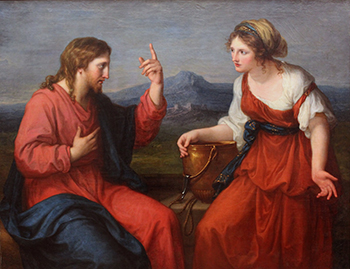
Angelika Kauffmann, The Water of Life Discourse (17th-18th c.).
|
The right to marry was restricted as well. Enslaved people could not marry. Roman soldiers could not marry. A Roman citizen could not marry a non-citizen. So again, the story that Jesus tells back to her about living with a man who is not her husband might have been understood by first century people as referring to systems of privilege from which the woman had become excluded. Jesus might have been saying to her, “I see you. I see how you’ve been tossed around like a sack of grain. I see what that must have done to your heart.”
All of this is fascinating and deeply revises my own understanding of this story, allowing me to see the misogyny in the tradition that has prevented many from delving into the depths of what Jesus and Photine discuss. But what does it or can it illuminate about the mystery of living water? Is living water “just a metaphor”?
At first Photine misunderstood the relationship between the water in the well and living water. She referred to all the mechanisms that we associate with water: buckets, wells, physical thirst, the labor that human beings must exert in order to meet their needs. Later in the passage the disciples make the same mistake when they confuse the experience of hunger with the “food you know not of” (John 4:32).
In the world in which Photine lived, the basic fact of the human need for water had become entangled in social, political, and even theological conditions. Who could drink from what well. Who had access to clean water and who did not. Who could offer water to whom and who could accept. (Some of this is still true, of course, in our own time.)
 |
|
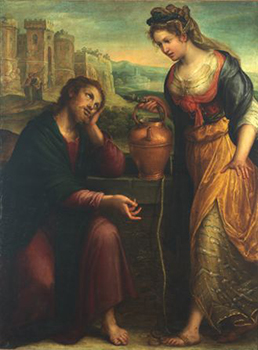
Lavinia Fontana, Christ and the Samaritan Woman (1607).
|
One of the things that Jesus offered, and that Photine enthusiastically accepted, was freedom from these conditions. He said to her, in essence, these distinctions we are making between Jew and Samaritan, between male and female, between those with power and privilege and those without are meaningless “in spirit and in truth” (John 4:23); they are contaminating the water from Jacob’s well. The hour is coming, Jesus says, when all of that will be replaced by a realm of love, abundance, and spiritual power. Indeed, Jesus tells her, “The Father seeks such as these” who are willing to recognize and live into this alternative realm (John 4:23).
The Samaritan woman understood that time to be now and believed the living water, “gushing up to eternal life,” was in her (John 4:14). Her neighbors likewise set aside their prejudices, certainties, and histories to enter into that moment.
I wonder what it would take for us to follow the Samaritan woman, to let her evangelize us as she did her neighbors. What would it take to see our own moment as abundant in living water? What old stories about ourselves and others would we have to surrender? What fears would we have to release? What future would we invite?
“We are not created to be forgiven,” writes the theologian Wendy Farley in The Thirst of God. We are created “to love and be loved.” Jesus has what Farley calls “an intense divine longing,” a longing so intense that it overcomes social, cultural, and geographic barriers. This longing is “the foundation of all of God’s actions in creation and redemption.” Jesus passes this thirst, an awakening of the heart for love, on to the woman at the well. Maybe as we accompany her through her thirst, we can be awakened to our own.
Weekly Prayer
Zeynep Hatun (15th c.)
I Am a Fountain, You Are My Water
I am a fountain, You are my water.
I flow from You to You.
I am an eye, You are my light.
I look from You to You.
You are neither my right nor my left.
You are my foot and my arm as well.
I am a traveler, You are my road.
I go from You to You.Translated by Murat Yagan.
Zeynep Hatun (15th c.) was one of the first significant female voices of Ottoman poetry. Little is known about her life, but sources agree that she came from a wealthy family, was well educated, and lived in Istanbul. Camille Helminski writes that “Zeynep Hatun [was] one of the strong women of Sufism around whom people have gathered for light and guidance in the Ankara region of Turkey for many years.” This poem comes from This Dance of Bliss: Ecstatic Poetry from Around the World, Ed. Ivan M. Granger (Poetry Chaikhana, 2018).
Amy Frykholm: amy@journeywithjesus.net
Image credits: (1) The Visual Commentary on Scripture; (2) Wikipedia.org; and (3) The Visual Commentary on Scripture.