From Our Archives
For earlier essays on this week's RCL texts, see Edwina Gately, An Urban Epiphany (2013); Dan Clendenin, Is The Stage Too Big for the Actors? (2010).
This Week's Essay
By Amy Frykholm, who writes the lectionary essay every week for JWJ.
John 1:1: “In the beginning was the Word and the Word was with God and the Word was God.”
For Sunday January 4, 2026
Lectionary Readings (Revised Common Lectionary, Year A)
Psalm 147:12–20 or Wisdom of Solomon10:15–21
Ephesians 1:3–14
John 1:1–18
My friend Brian has lived in the woods for several years now. Maybe it’s better to say that he has lived with the woods, because the woods have been friend, enemy, interlocutor, companion, source of wisdom and source of terror. He has built a lean-to where he lives all year long, even in the harsh winter conditions that are part of living at 10,000 feet of elevation. He has a wood stove and some insulation, but not much.
He spends much of his time and energy in the summer building up his wood supply for winter. He once described to me exactly how much dead standing wood he needs to down and drag to his camp, including his estimate of exactly how many hours it takes to process all this wood so that it can be used in his stove. His is a precarious, difficult, and basic life. If I ask him, on the rare occasions when I see him, how he is, he says, “Chopping wood. Carrying water.”
While it’s tempting to romanticize the simplicity of Brian’s life, I’ve watched the physical toll it takes on him. One winter, he disappeared for several weeks. We were just about to organize a search party when he reappeared—pale, shaken, extremely thin, and dehydrated. He’d hurt his back and had been unable to make it into town. This incident led one community member to supply him with a winter cell phone, but he still must get into town to charge it, and that is not easy.
Brian has a lot of stories about animal life that are part of his existence in the woods. Of all the woodland creatures, he says, squirrels are the hardest to live with. They are incessantly noisy, invasive, and pestering. They like to heckle. At first, he went to battle with these small invaders, trying to drive them out of his camp. He yelled at them, threw things at them, and tried to scare them away. They did not frighten easily. He tried urinating around the woodpile, hoping the scent would repel them. “I was literally in a pissing contest with squirrels.” He shook his head. That also failed. “The only thing that worked,” he told me, “was singing to them. I just started singing to them, and that calmed them.”
He also told me about the pine marten who loved to sneak slyly into his camp. It figured out how to open (and close!) his sealed food bin and seemed to have a penchant for breakfast burritos. More than once he found a burrito wrapper just outside his camp with no evidence of who had retrieved it from the bin.
 |
|
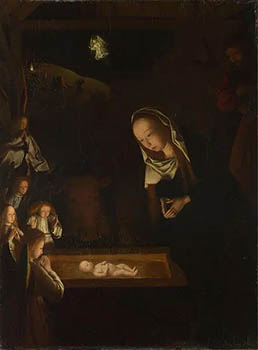
Geertgen tot Sint Jans, The Nativity at Night (c.1490).
|
But Brian’s primary companion these days is silence. Early in his experiment in the woods, he would listen to NPR all day, coming into town to charge his phone to keep these voices as a presence. But gradually, his need for those human voices died down, and he became more accustomed to living with the silence. The silence has gradually deepened.
“God’s first language is silence.” Christian contemplative Thomas Keating comments on this insight from St. John of the Cross in his book Intimacy with God by adding, “Everything else is a poor translation. In order to understand this language, we must learn to be silent and to rest in God.” But those who live with a great deal of silence—the record we receive from the desert mothers and fathers and from modern-day ascetics like Brian—teach us that silence is not always or even most often a restful companion.
In her memoir A Book of Silence, Sara Maitland describes the “dark side” of silence. She went to live alone on the Isle of Skye off the coast of Scotland and spent many weeks in complete silence, which was most of the time companionable and easeful. But every so often she was seized by a panic that she attributed to the silence. It would seem to scream. She was not “frightened of” or “scared by” the silence. Rather, it was “something much lower down and further in, something really visceral.”
That experience sheds a certain light on my own daily life and the active way I avoid silence. In 1999, before the takeover of our lives by the Internet, researchers estimated that the quantity of digital data generated worldwide came to 1.5 billion gigabytes. By 2024 that estimate was 147 trillion gigabytes and growing daily.
 |
|
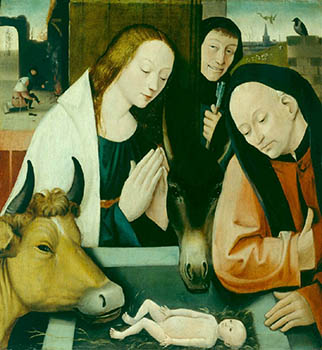
Anonymous, The Adoration of the Shepherds after Hieronymus Bosch (c.1550).
|
This has translated into a world inundated by words. There’s a common complaint that no one reads anymore, but that’s not remotely true. We read all the time. If we spend, on average, six hours per day interacting with our screens, a sizeable percentage of that is the consumption of words: texts, podcasts, audiobooks, social media and newspaper scrolling—all of these are words which demand our attention. And algorithms are getting better and better at delivering to us, out of the infinite number of words in the universe, the words that we most want to consume.
All of these words create a cacophony. The noise begins when we first wake up and continues in a flow until we go to bed at night.
And for many of us, our goal is not to consume less, but to consume more. There are endless lists of podcasts to listen to, news articles bookmarked, emails to answer, Substacks to read, videos and TV shows to watch, not to mention the ever-growing list of books that we hope to get to. And here I am adding to the inundation of words by writing this essay. It’s a flood, and there are days when I feel like I am drowning in it.
According to the Gospel of John, Christianity roots itself, not exactly in silence, but in the Divine Word. “In the beginning was the Word and the Word was with God and the Word was God” (John 1:1). The primary word is, in the Gospel of John, the Logos, spoken from the beginning of time. It’s a singular word, the Word before all other words. Not infrequently in the tradition, we have paradoxically interpreted this Word, as Keating does, as silence.
 |
|
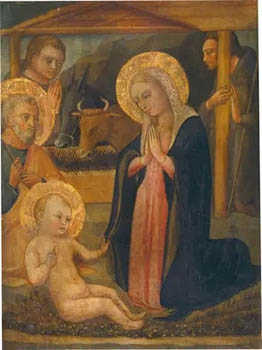
Bicci di Lorenzo, The Adoration of the Christ Child (c.1440).
|
I don’t know if the Divine Word makes a sound. From this passage in John 1, I understand that the Divine Word is at the very root of Incarnation. Logos is both the source of everything and the ongoing sustenance of it. It is not static. It is always moving in and through us and through all living things. It wasn’t spoken once for all time, but as the eternal word is always and everywhere still being spoken. Human language is just one small part of this Logos.
But very often missing in Christian discussions of the primary word is what is then compelled from us as humans. If God spoke first and brought us into being through Word, then the purpose of the human is perhaps nestled profoundly in the Hebrew word for soul, neshama, one who listens. The Listening One is the image and likeness of God; it is the divine connection present in each person. The divine-human relationship is one of listening.
In his book Between the Listening and the Telling, Mark Yaconelli writes, “There are certain ‘pure medicines’ that every wisdom tradition makes available to the lost and disheartened. Silence. Song. Story. These are the ancient remedies to nourish the withered soul. These are the practices that cause the sap to rise.” All of these require an ever-deepening capacity to listen. That is our primary response to the primary word.
Weekly Prayer
Johann Wolfgang von Goethe (1749-1832)
You may hide yourself in a thousand forms,
Still, All-beloved, I recognize you;
You may cover yourself in magic mists,
All-present, I can always tell that it is you.
I discover you as well, All-beautifully-growing,
In the cypress's pure young surge,
In the stream's fresh, living rush,
All-enchanting, I know you well.
When rising jets of water unfurl,
All-playful, how glad I am to see you;
When clouds form and transform themselves,
All-manifold, I discern you in them.
In the blossoming tapestry that covers the meadow,
I see your All-colorful, starry beauty;
When ivies reach their thousand arms around,
I meet you, All-embracing.
When morning lights the mountain range
I greet you there too, All-brightening,
Then, as the sky grows round above me,
All-heart-expanding, it is you I inhale.
What, with out and inner senses, I know,
I know only through you, All-teaching;
When I name Allah's hundred names,
A name, with each name, re-echoes for you.Translated by John White.
Johann von Wolfgang Goethe (1749-1832) was a German writer, scientist, poet, statesman, and critic who is widely considered the most influential writer in German.
Amy Frykholm: amy@journeywithjesus.net
Image credits: (1) Artist Trust; (2) Wikimedia.org; and (3) Musefully.org.