From Our Archives
For earlier essays on this week's RCL texts, see Dan Clendenin, But What About You? (2023); Debie Thomas, But What Do You Think? (2020); and Dan Clendenin, Yes and No (2017).
This Week's Essay
By Amy Frykholm, who writes the lectionary essay every week for JWJ.
Romans 12:1–2: “Be transformed by the renewing of your minds.”
For Sunday August 23, 2026
Lectionary Readings (Revised Common Lectionary, Year A)
Psalm 124 or Psalm 138
Romans 12:1–8
Matthew 16:13–20
“I appeal to you therefore, brothers and sisters, in light of God’s mercy, to present your bodies as a living sacrifice, holy and acceptable to God, which is your reasonable act of worship. Do not be conformed to this age, but be transformed by the renewing of your minds, so that you may discern what the will of God is — what is good and acceptable and perfect” (Romans 12:1-2).
It is tempting to begin this essay with a litany of all the failed ways that I’ve attempted to “present [my] body as a living sacrifice.” I memorized these verses in the basement of Trinity Baptist Church in Sioux Falls, South Dakota. They should have come with a warning label: could cause exhaustion and excessive dryness of spirit.
As I recall, no one attempted to explain the verses to me. The teachers gave me a reward — I don’t remember what — for my deft memorization. And to their credit, I can still rattle off Romans 12:1–2 with almost all the words in the right places.
But then I went out into the world and tried to live it. I encountered the try-hard spirituality of the world around me: self-improvement culture, perfectionism, martyr complexes, the labor of a thousand things that were not mine to do. I encountered the dualism of the Christian culture in which I was raised that had divided mind and body. I took their distance from each other for granted and labeled one good and the other bad. This was aided by a religion encrusted with so many gender stereotypes that the word “sacrifice” had “female” stamped all over it.
 |
|
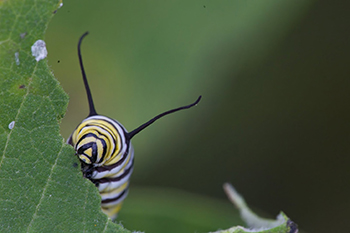
Ryan Hagerty, Monarch Caterpillar.
|
In other words, I worked on being “perfect” in all kinds of ways.
I skipped right over the word “living” while I tried to deaden my own appetites so that I could practice a martyr-like service to others. I cut off aspects of myself so that I could conform to what I thought was righteousness. I spent a lot of time and mental energy imagining and attempting to enact the holiness that I thought these verses demanded of me. But these attempts did not awaken me spiritually or deepen my understanding. They left me frustrated, exhausted, and full of self-loathing.
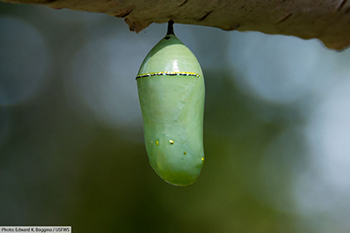
I saw these verses as items on a spiritual to-do list. 1) Offer your body as a living sacrifice. 2) Do not conform to this world. 3) Be transformed (as if the self could transform itself by fiat any more than a caterpillar can will itself into a butterfly as it dissolves in its chrysalis. Other forces have to be at work.)
Once you are perfect — have all the items checked off — God will be happy.
But perhaps none of this is the fault of these verses. Let me highlight three aspects that I completely overlooked for most of my life.
The first is body. The Greek word that Paul chooses here is soma. Soma is not simply the physical body as our own word has come to mean. We often mean body in opposition to mind or to soul. But soma is not necessarily oppositional. (Paul has a word for that more dualistic understanding: sarx, typically translated flesh.) But here a translation like “whole self” might be better than body: The intricate systems of your physical body. Your heart, mind, and strength all working together. Your embodied soul. Your unified being. Your unique self with its unique talents, unique perceptions, unique ways of walking and speaking. The total, vulnerable, flawed humanness that is you. This whole self — which can take a lifetime even to encounter, let alone offer — is what is being invited into a relationship with the Creator, a relationship that is called “sacrifice” or “offering.”
 |
|
Monarch Butterfly Chrysalis.
|
Then there is the word “living.” I think for most of my life, I held the concept of biological life here. While you have breath, while you are in this body, live this way. But the Greek word used here for living is not bios, biological life, but zoe, the same life as in “living water.” In other words, there are multiple levels of vitality that are evoked by this simple word. I know now much better than I did then all of the ways that this world wants to steal your zoe. But how we keep ourselves alive in this deeper sense is a crucial aspect of the spiritual life. Perhaps the means that each of us finds toward zoe — the life of our life — is as unique as our soma. But it is a profound spiritual responsibility that each of us has.
Perhaps we can carry forward the aliveness in verse 1 to verse 2, and notice that zoe is what’s at stake as we “conform” to the pressures, habits, stereotypes of our age. If we let this age shape us, then we lose something vital. Most of us already know this because of our age’s relationship to screens. We can almost feel the life force being sucked from us by blue light. But that’s just one piece of a problematic whole.
Two things are important for me to remember here before I go on a long rant against my age. One — we are all shaped by our social, cultural, and temporal contexts. That is a key aspect of being human. There is no other way to become a person. Two — the problem of conforming to one’s age was as true in the first century as it is today. The pressures and habits were different, but their capacity to distort and steal our zoe was as real.
So that leads us to the third concept that has changed my relationship to this passage: “be transformed by the renewing of your minds.” “Mind” here is the complex Greek word nous. Nous does mean mind, but not in the sense of mental versus physical that we have inherited and that inhibited my understanding of soma.
 |
|
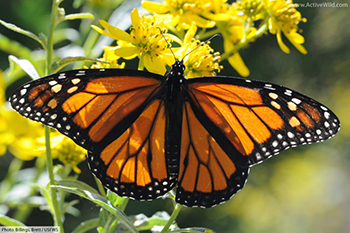
Adult Male Monarch Butterfly.
|
In Walter Bauer’s lexicon of New Testament Greek, the first thing he notes about nous is that it involves our powers of perception. Some perception comes from the brain’s insight. But some of it comes from emotional intelligence, the cultivation of sensory capacities, intuition, and various other kinds of intelligence that occupy our beings. Perception is more important to nous than particular kinds of thoughts. Attention is more vital than smarts. Nous is not just our heads.
So in light of soma, zoe, and nous, I sat down this week and tried out this translation that I could almost imagine offering to that child in South Dakota.
“So then, I ask you, my dear family, in light of all the mercy, compassion, and kindness that God has shown us, place your whole selves in God’s hands — mind, heart, strength — this whole embodied being that is you. Make that offering full of life and vitality, as living as living water. The depth of your spiritual understanding and your willingness will fill the heart of God with joy.
And do not let the ways of this world — its greed, ambition, empty fulfillments — mold and shape you, make you like itself. Instead be transformed through the renewal of your perceptions. Seek every opportunity to see with new eyes, hear with new ears, try out new paths, feel things for the first time and let them sink into your heart. From your heart, your mind, your senses, and your intuition, let yourself be continuously renewed. In this way, you will know what to do, how to act, how to choose the good, the true, the beautiful, the holy, and the whole.”
Weekly Prayer
D.H. Lawrence (1885–1930)
Song of a Man Who Has Come Through
Not I, not I, but the wind that blows through me!
A fine wind is blowing the new direction of Time.
If only I let it bear me, carry me, if only it carry me!
If only I am sensitive, subtle, oh, delicate, a winged gift!
If only, most lovely of all, I yield myself and am borrowed
By the fine, fine wind that takes its course through the chaos of the world
Like a fine, an exquisite chisel, a wedge-blade inserted;
If only I am keen and hard like the sheer tip of a wedge
Driven by invisible blows,
The rock will split, we shall come at the wonder, we shall find the Hesperides.
Oh, for the wonder that bubbles into my soul,
I would be a good fountain, a good well-head,
Would blur no whisper, spoil no expression.
What is the knocking?
What is the knocking at the door in the night?
It is somebody wants to do us harm.
No, no, it is the three strange angels.
Admit them, admit them.D.H. Lawrence (1885–1930) was an English novelist, playwright, travel writer, essayist, and poet whose work reflected on modern society. He was widely censored in his time for radical portrayals of romance and sexuality and he spent much of his adult life in exile.
Amy Frykholm: amy@journeywithjesus.net
Image credits: (1) U.S. Fish & Wildlife Service; (2, 3) ActiveWild.com.