From Our Archives
For earlier essays on this week's RCL texts, see Michael Fitzpatrick, Passionate Love for the Kingdom of Heaven (2023) and The Good News that God is For Us (2020); and Dan Clendenin, Asking for Anything (2017) and You Belong to God (2014).
This Week's Essay
By Amy Frykholm, who writes the lectionary essay every week for JWJ.
Romans 8:26: “Likewise the Spirit helps us in our weakness, for we do not know how to pray as we ought, but that very Spirit intercedes with groanings too deep for words.”
For Sunday July 26, 2026
Lectionary Readings (Revised Common Lectionary, Year A)
Psalm 105:1–11, 45b or Psalm 128 or Psalm 119:129–136
Romans 8:26–39
Matthew 13:31–33, 44–52
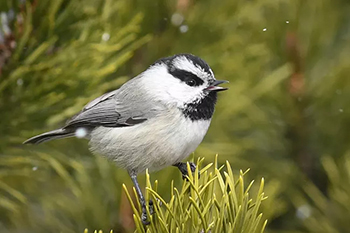
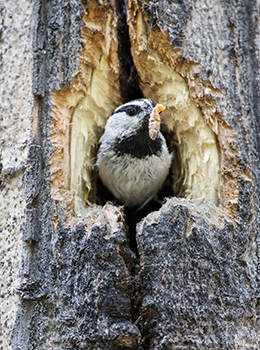
The first thing I saw of the new chickadees this year was their mouths — bright orange-yellow against the dark background of the nesting box hanging from the fence in our back yard. This is the second year in a row that we’ve been graced by nesting mountain chickadees.
Nothing could be more important to a new chickadee than a mouth. Spread wide, poking out of the box, squawking grandly as it waits for one of its parents to return. Mouths are how I know there are baby chickadees in the box. After a few days I hear the telltale peeping. I hear it after every trip the parents tirelessly make to bring food and carry out soiled fluff from the nest. Then after a few more days, I see the first mouth — and it seems like that is all the tiny bird is.
Eventually there are two or more competing mouths at the hole in the box. Then whole heads emerge looking around eagerly for the appearance of the parents, and the chicks climb on top of one another in a feathery scrum to reach the front.
 |
|
Rachel Ames, Mountain Chickadee Calls from a Ponderosa Pine Tree. |
A few more days and the chickadees decide to fly, peeping the whole time, letting me know this is the day. Keep an eye out. Here we come. Now, a few weeks later, they sing their more complex juvenile song to me from the spruce tree and sometimes up on the telephone wire. We’re here, they say. Don’t worry about us. Over the years of watching these birds, my ear has become highly attuned to their song. I know when they’re born; I know when they are ready to fledge; I know when they are nearby. I wonder if they too have become accustomed to my voice, if we sing to each other.
I usually dread the appearance of Psalm 119 in the lectionary as it does this week. I am the default cantor at my church, and my heart never thrills to chant the repetitions of “decrees” and “laws” and “commandments” that are so much a part of this psalm — at least as it is usually translated for us, into English, in the Christian tradition. I find it exhausting and it reminds me of all of the failed rule-following I’ve tried as a spiritual path. Rendered in English, Psalm 119 feels a little dead in the water to me.
My friend and writing companion Rabbi Jamie Arnold has been writing about and translating the psalms for some years now and is currently sharing his work on his Substack. Recently, he has tackled the behemoth of Psalm 119. He sees this psalm quite differently. This psalm, he says, is meant for spiritual practice, not of the rule-governed kind, but of the kind that responds to the love of God with joy. His advice to those who want to go deeper into this psalm is not to say it, but to experience it — and I admit this works better with his translations than with the ones printed in my prayer book.
Psalm 119 is a repetitive acrostic psalm that, to some degree, gains its power by its untranslatable reliance on the Hebrew alphabet. Eight verses belong to each of the 22 letters of the Hebrew alphabet, making the psalm 176 verses in total. Every line of the eight in each section begins with the same letter. The psalm as a whole is an invitation to discernment, to a way of praying that attunes us to God’s own movement in the world.
Hebrew letters are not quite the same as English letters. Even though we can say that the letter ה heh is like the letter h in English, letters themselves do not mean the same thing in both languages. In English a letter stands in for a sound or a complex of sounds. But in Hebrew a letter is both a sound and an entire symbolic system. In this week’s lectionary, the section of Psalm 119 is פ peh, and it represents a mouth: closed on three sides. On the open side, it has a tooth hanging down.
 |
|
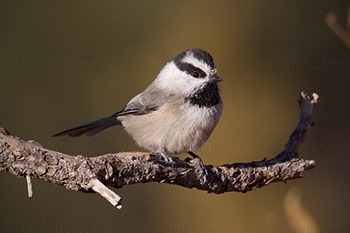
Christopher Taylor, Mountain Chickadee (2012).
|
The mouth of peh is open, as in Psalm 51:15, “Open my lips and my mouth shall declare your praise.” Peh, then, is a hint for how to read these verses, even in English.
In the section peh, the psalmist draws our attention to divine communication. “Wondrous are your words, therefore my soul keeps them,” the section begins (Psalm 119:129). This raises a number of questions, among them: What is the language of God? How do we hear God’s words?
The anthropologist David Abram notes how rich in speech the entire world is. In his book The Spell of the Sensuous, he writes, “At the most primordial level of sensuous bodily experience, we find ourselves in an expressive, gesturing landscape, in a world that speaks.” In a world this rich in languages of different kinds, divine communication cannot be limited to the few words people have attempted to record. The divine has a multiplicity of communication strategies, mouthpieces, and means. But not all of these are obvious. Some of them are hidden, secret. Some of them we don’t, as Jesus often tells us, “have ears to hear.”
But if we do hear divine speech, however it is we hear it, our natural response, the psalmist says, is wonder and an attempt to somehow hold on to it, to “keep” it, treasure it. It’s worth pausing here to try to heed Jamie’s advice. Instead of merely saying that we find God’s word wondrous, what would it be like to experience God’s communication, to wonder at it, to treasure it? When have you had this experience? What’s the clearest communication you’ve ever had from God? What means did you have to “keep” it?
In the second verse (119:30), the psalmist says that the opening — portal, doorway, entrance, mouth — of the words of God is light. We’re reminded of the first words that God says in Genesis 1, “Let there be light.” The foundation of divine communication is light and it seeks our own illumination. As God’s speech sheds light on the world around us, we learn to see and hear it, as if for the first time. In the light of divine speech, everything around us begins to shine and to speak. We live in a world animated by love.
As human beings, we rely on this divine light to bring meaning, purpose, and understanding to the world. If we pray at all, it is because divine speech created the world and ends up praying for us, through us. It is because the whole world is already expressing creative, sensuous, outpouring love.
 |
|
Danita Delmont, Mountain Chickadee in Nest Cavity.
|
But in the third verse of peh, the human being tries to respond to divine speech, and all that comes out of the open mouth is panting. This verse (119:31), “With open mouth, I pant/ because I long for your words,” reminds us of Psalm 42, which also equates our longing for God as the most fundamental desire that we have — thirst. “As a deer pants for streams of water, so my soul pants for you, Oh God” (Psalm 42:1).
It’s a basic, elemental form of communication, as basic perhaps as that peep of the open mouth of the chickadee, clamoring with utter dependence on its parent for survival. For all our gifts of language, we fall short when we encounter this light. Walt Whitman writes,
When I undertake to tell it best, I find I cannot.
My tongue is ineffectual on its pivots,
My breath will not be obedient to its organs,
I become a dumb man.
Maybe, if we follow Rabbi Jamie’s idea that this psalm is better experienced than recited, we can pause and feel the frustration that is inherent in our human lives and human language. We open our mouths and nothing but panting comes out. Thus the quatrain ends with a plea for mercy. “Look upon me and be gracious to me,” the psalmist asks (119:132). In the end that is our most fundamental prayer.
Weekly Prayer
Patrick Kavanagh (1904–1967)
Leafy-with-love banks and the green waters of the canal
Pouring redemption for me, that I do
The will of God, wallow in the habitual, the banal,
Grow with nature again as before I grew.
The bright stick trapped, the breeze adding a third
Party to the couple kissing on an old seat,
And a bird gathering materials for the nest for the Word
Eloquently new and abandoned to its delirious beat.
O unworn world enrapture me, encapture me in a web
Of fabulous grass and eternal voices by a beech,
Feed the gaping need of my senses, give me ad lib
To pray unselfconsciously with overflowing speech
For this soul needs to be honoured with a new dress woven
From green and blue things and arguments that cannot be proven.
Patrick Kavanagh (1904–1967) was an Irish poet and novelist. When the Irish Times compiled a list of favorite Irish poems in 2000, ten of Kavanagh's poems were in the top 50, and he was rated the second favorite poet behind W.B. Yeats. The actor Russell Crowe said, “I like the clarity and the emotiveness of Kavanagh. I like how he combines the kind of mystic into really clear, evocative work that can make you glad you are alive.”
Amy Frykholm: amy@journeywithjesus.net
Image credits: (1) National Park Service; (2) Christopher Taylor Nature Photography; and (3) American Bird Conservancy.