From Our Archives
For earlier essays on this week's RCL texts, see Dan Clendenin, Befriending My Brokenness (2023); Debie Thomas, Welcome the Prophet (2020); Dan Clendenin, A Terrifying Text: Abraham and Isaac on Mt. Moriah (2014), and A Rabble of Blasphemous Conspirators (2011).
This Week's Essay
By Amy Frykholm, who writes the lectionary essay every week for JWJ.
Psalm 13:3: “Consider and answer me! Give light to my eyes.”
For Sunday June 28, 2026
Lectionary Readings (Revised Common Lectionary, Year A)
Psalm 13 or Psalm 89:1–4, 15–18
Romans 6:12–23
Matthew 10:40–42
According to Genesis, these are the last words that God spoke directly to Abraham: “Take your son, your only son Isaac, whom you love, and go to the land of Moriah and offer him there as a burnt offering on one of the mountains that I shall show you” (Genesis 22:2). After this, Abraham never again hears the voice of God.
This is the nightmare of every person who has ever wanted to put their faith in God. Abraham, known for his faith, is now commanded to do this most horrible, most unimaginable, most tragic thing: sacrifice his own child, whom, the voice of God notes as if taunting, “you love.” And this sacrifice is demanded for reasons so mysterious that generations of Torah scholars and devoted readers of Christian, Muslim, and Jewish faiths have tried to comprehend it without success.
All of the stated reasons — obedience, the need for sacrifice in the life of faith, testing of our devotion — feel hollow as we apprehend what is actually being asked of Abraham. The most I can say for this story is that it has kicked off a 5,000-year, still unresolved, conversation about obedience, sacrifice, and faith.
Prior to Genesis 22, God has much to say to Abraham. God begins the conversation by telling him to “Go forth” (Genesis 12:1). God tells him about the land that he will receive (Genesis 13:14). God tells him that his descendants will be more numerous than the stars (Genesis 15:5). God tells him he will have a son (Genesis 18:10).
But now, God’s last words appear to erase all the former promises. He orders Abraham to offer up his own son in a fiery act of sacrifice. This command, Søren Kierkegaard writes, should render any follower of God sleepless. Ask me to sacrifice myself, OK. But ask me to sacrifice my child? That is the end of the conversation.
 |
|
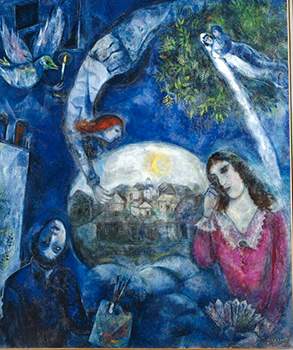
Marc Chagall, Around Her (1945).
|
But to prevent the conversation from ending, Jewish tradition surrounds texts like these — some of the most ancient and revered — with other stories in a practice called midrash. Sometimes, in the process of midrash, characters or scenes are invented by readers and commentators that are intended to illuminate some of the seemingly impenetrable darknesses of the original story. Through the process of midrash, we’re reminded that the text is never without context. There is always more to the story.
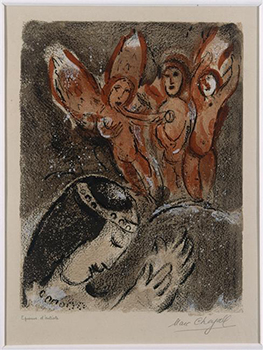
Many midrashists have asked: Where was Sarah when this command was given to Abraham? A variety of stories have emerged in an attempt to address this lacuna in the text. In one contemporary midrash, Rivkah Lubitch imagines that God comes to Sarah first and says, “Take your son, your only one, whom you love, Isaac, and take him to the land of Moriah and offer him up.” Sarah says to God, “No. A mother does not slaughter her children.” Thus Sarah, Lubitch imagines, passes the so-called “test.”
The next morning Sarah discovers that neither Abraham nor Isaac are present. With horror, she recognizes that God said the same thing to Abraham, and he has made a completely different decision. She lifts up her arms to God and says, “I know that one who slaughters his son in the name of God will in the end be left without a son or God. Forgive Abraham, who was mistaken about this.” At this moment, the midrash says, the angel of God calls out, “Abraham, Abraham, do not lay your hand on the boy” (Genesis 22:11–12). And in this way, all three are saved.
 |
|
Marc Chagall, Sarah and Angels (1960).
|
I love Sarah’s no in this story. It comes out of her own wisdom, out of her own struggle and suffering. It also comes out of her instincts: the God of love would not ask me for something like this. Sarah’s full engagement — her whole self — contends with God in this moment. Sarah sees the threat that everything could be lost: not only her child, but also her relationship with God, with her faith, with the foundation of her life. And the same is true of Abraham.
There are many places in the Hebrew Bible that teach us that our relationship with God is a conversation. In Genesis 18, Sarah’s laughter about the possibility of Isaac’s birth opens up a conversation with God about the meaning and purpose of destiny. Later in the chapter, Abraham himself negotiates with God about the fate of Sodom. Jacob wrestles with the angel. Moses enters into a long conversation with God about the fate of the Israelites. While there are many commands in these texts, the God of the Torah seems to require our engagement, our willingness to take up the conversation, to wonder, to question, and perhaps even to say no.
But the binding of Isaac has never been one of those stories. Perhaps because of its terrifying nature, because God is asking the absolute impossible, the binding of Isaac has most frequently been taken as a straightforward story about obedience. Abraham trusts God, even in the midst of this terrible demand, and that is righteousness.
 |
|
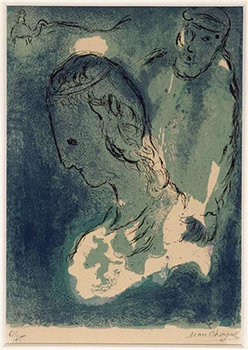
Marc Chagall, Sarah and Abraham (1956).
|
Sarah’s refusal calls this into question. It reminds us that there are a thousand ways to shirk our responsibility when it comes to the ongoing, life-long, profoundly demanding conversation with God. Maybe we imagine that we already know what God is asking of us, and we follow our sense of duty blindly. Maybe we turn over our inner authority to another human being. Maybe we doubt ourselves and our own perceptions so much that we don’t hold up our end of the conversation. Maybe we think we hear the voice of God and we’re just wrong. Maybe we ignore God’s inquiry into our lives. Maybe we silence our inner protest.
One of the things I learn from Sarah’s refusal is that, without engagement and intimacy, obedience is a mindless and brutal enterprise. True intimacy with God is both a conversation and an evolution that emerges from a willingness to speak from our own integrity. Looked at from this direction, God’s demand that Abraham kill Isaac is a strange gift, but a gift nonetheless. The absurdity of it shakes my sense of reality. It breaks open my cozy, self-satisfied, pre-packaged notions of God. If God only ever tells me what I want to hear, then no conversation is possible.
Instead we might notice that to avoid becoming a dictator, God needs us to participate, to hold up our end of the conversation. We might then notice, as the 14th century Persian poet Hafiz does, that “the sword drops from [our] hands...because we have finally realized there is just one flesh we can wound.”
Weekly Prayer
Pádraig Ó Tuama (b.1975)
I used to need to know
the end of every story
but these days I only
need the start to get me going.God is the crack
where the story begins
We are the crack
where the story gets interestingWe are the choice of
where to begin
the person going out?
the stranger coming in?God is the fracture
and the craic in your voice
God is the story
flavoured with choiceGod is the pillar of salt
full of pity
accusing God
for the sulphorous city.God is the woman who bleeds
and who touches
We are the story
of courage or blushes.God is the story
of whatever works
God is the twist at the end
and the quirksWe are the start
and we are the centre
we’re the characters
narrators, inventors.God is the bit
that we can’t explain
maybe the healing
maybe the pain.We are the bit
that God can’t explain
maybe the harmony
maybe the strain.God is the plot
and we are the writers
the story of winners
and the story of fightersthe story of love
and the story of rupture
the story of stories
the story without structure.Pádraig Ó Tuama (b.1975) is an Irish poet and theologian. He hosts On Being’s podcast Poetry Unbound. He received a PhD from the School of Critical Studies (Creative Writing and Theology) at the University of Glasgow.
Amy Frykholm: amy@journeywithjesus.net
Image credits: (1) SevenPonds; (2) Artchive; and (3) WikiArt.