From Our Archives
For earlier essays on this week's RCL texts, see Michael Fitzpatrick, Buried with Christ (2023); Debie Thomas, What To Fear (2020); Dan Clendenin, His Eye is on the Sparrow (2014); and Brad Keister, How Do We Love Burma? (2008).
This Week's Essay
By Amy Frykholm, who writes the lectionary essay every week for JWJ.
Psalm 86:1: “Listen to me, answer me, for I am desperate.”
For Sunday June 21, 2026
Lectionary Readings (Revised Common Lectionary, Year A)
Psalm 86:1–10, 16–17 or Psalm 69:8–20
Romans 6:1b–11
Matthew 10:24–39
When I arrived at the Maria Skobtsova refugee house in Calais, France in the summer of 2023, the story of Asmarina (not her real name) was still fresh in everyone’s minds. Asmarina was 24 years old when she fled her native Eritrea with her seven year-old son. She was terrified of the regime’s militarization of young boys and wanted to spare her son the only path that the country made available: to fight on the border with Ethiopia. Children are abducted and conscripted into the army at young ages. Sometimes they disappear without their parents knowing what has happened.
Asmarina found a way for herself and her son out of the country. But that was only the beginning of their ordeal. In the chaos that followed and their trek across Africa, she was separated from her son as they crossed the Sahara. No one at the refugee house knew exactly how. They only knew that she spent seven years looking for him, inquiring at every nongovernmental and international agency, crossing borders in search of him. By some miracle, they were in fact reunited.
 |
|
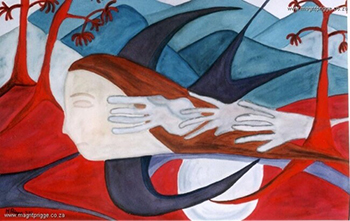
Margrit Prigge, Hagar (1997).
|
But again, this was not the end of their struggle. This part of the story the people in Calais were very familiar with. They had lived this part with her. Having reached Calais, Asmarina, her son, and two additional children who had been born in the intervening years were preparing to cross the Channel on one of the many flimsy boats that smugglers use to bring refugees from France to the United Kingdom. They reached the appointed location and her son boarded the boat, followed by the two other children, ages nine and five. Just as she herself was about to board, the smugglers became spooked that the police were arriving. They launched the boat before Asmarina was able to board. She fell into the water in a faint. Someone called an ambulance.
For the next month, Asmarina tried desperately to be reunited with her children, who had landed safely in England. After attempting to work through a number of agencies, Asmarina again boarded a smuggler’s boat and crossed into the United Kingdom. She told The Guardian, “I am their mother. I need to be with them. I cannot be separated from them. My children are my whole life. I just want to be reunited with them and to see them grow up in safety and security.”
 |
|
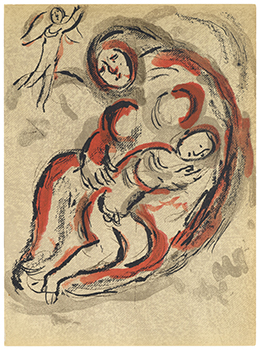
Marc Chagall, Hagar in the Desert (1960).
|
The first time we meet Hagar in Genesis, she is being “given” to Abraham by Sarah, because Sarah hopes that she will give birth to a son and secure Abraham’s legacy. She does, in fact, give birth to a son, Ishmael, but Sarah turns against her and Abraham is indifferent to her. “Your maid is in your power,” he tells Sarah, “do to her what is good in your sight” (Genesis 16:6). The result is that Hagar is so cruelly treated by Sarah that she flees to the wilderness. An angel finds her there, promises her that she will be the mother of a great nation, and sends her back to Sarah.
The second time we meet Hagar, Sarah now has a son of her own. She again turns against Hagar. This time instead of Hagar fleeing of her own accord into the wilderness, she is cast out by Abraham and Sarah. She wanders in the wilderness until the water Abraham has given her to drink is gone, and she decides that both she and the boy will die. She lays him down under a broom tree, lifts up her voice in weeping, and waits for death. Instead another angel visits Hagar and shows her a well of water. Both she and the boy survive and thrive.
This is an astonishing story to find amongst the accounts of the patriarchs and matriarchs of Genesis. It follows not the perspective of the householders, but the perspective of the slave. Not the ones who are awaiting their destiny to be fulfilled by God, but the one who is collateral damage along the way. Hagar is the archetypal mother of every person who has ever been exiled, who has fled violence, both domestic and governmental, every person who has found themselves shunned, discarded, trafficked, forgotten.
 |
|
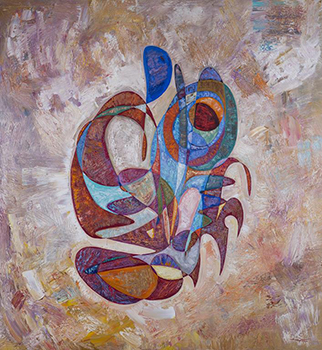
Gheorghe Virtosu, Hagar Wife of Abraham (2016).
|
When I think of Asmarina in the deserts of the Sahara, searching for her son, when I imagine her on the beach at Calais once again facing an unthinkable separation, I think of the angels that Hagar meets in the wilderness. The first angel says to her, “Hagar, Sarai’s maid, where have you come from and where are you going?” (Genesis 16:8). The angel knows Hagar’s identity as “Sarai’s maid,” but that doesn’t seem to be the root of the question. The angel is asking after another identity, one that is not attached to Sarah. After this encounter, Hagar calls God “the one who sees” (Genesis 16:10). I imagine what it might have been like for an angel like that to meet Asmarina. “Asmarina, child of Eritrea, where have you come from and where are you going?” I wonder if Asmarina ever felt seen.
The second angel also has a question. “What troubles you, Hagar?” the angel asks. And then the angel offers reassurance, this time not of a God who sees, but of a God who hears. “God has heard the voice of the boy,” the angel assures her (Genesis 21:17). I wonder if Asmarina ever felt heard.
In poet Mohja Kahf’s book Hagar Poems, Kahf takes the reader on a journey with Hagar, imagining the wilderness as any place where a refugee lands. In a poem entitled “The Water of Hajar,” she writes,
Where on this earth
is the water of Hagar
the water that came
up from the ground,
from the ground of Hajargiven
freely, freely
by the God of Hajar.
Hagar is the only person in this story who awakens. Sarah imagines herself a victim and blames Hagar. Abraham imagines that his choices are Sarah’s fault. Even God in much of this story simply tells people what they want to hear. But Hagar, in the midst of her suffering, awakens to what is near her (the well), to what is within her (the power), and to the God who hears and sees. From this she creates, even in the wilderness, a life and a future for herself and her child.
Weekly Prayer
Mohja Kahf (b.1967)
I am Hagar the immigrant
There came to me the revelation
of the waterI left the world of Abraham,
jugs sealed with cork,
cooking-grease jars,
Sarah’s careful kitchen firesI walked across a razor-sharp horizon,
slates of earth, sediment
of ancient seasto stand alone at this frontier:
where the shape of the cup of morning is strange
and dome of sky, mat of earth have shifted,
where God does not have a house yet
and the times for prayer have not been appointed,where the only water is buried deep
under hard ground and I must find it
or my child will die, my people
remain unborn
The first thing
the founder does
is look for waterI am Hajar, mother
of a people
I stand here
straddling the end and the beginningEach rock cuts into the heel like God
Each step is blood, is risk:is prayer
Mohja Kahf (b.1967) is a scholar and poet who was born in Damascus, Syria and raised in the American Midwest. She is the author of two collections of poetry and a novel. She teaches at the University of Arkansas. This poem is from a collection called Hagar Poems (University of Arkansas Press, 2016), p.4-5.
Amy Frykholm: amy@journeywithjesus.net
Image credits: (1) Art Majeur; (2) Art & Object; and (3) Virtuso Art Gallery.