From Our Archives
For earlier essays on this week's RCL texts, see Dan Clendenin, Is Anything Too Difficult for the Lord? (2023) and Debie Thomas, I Am Sending You (2020).
This Week's Essay
By Amy Frykholm, who writes the lectionary essay every week for JWJ.
Leonard Cohen: “God is alive, magic is afoot.”
For Sunday June 14, 2026
Lectionary Readings (Revised Common Lectionary, Year A)
Psalm 116:1–2, 12–19, or Psalm 100
Romans 5:1–8
Matthew 9:35, 10:8–23
One day when I was in the kitchen at my church’s Community Meal, one of our regular guests came in for lunch with a Buddhist monk. The regular guest was named Alpine, and he had a camp out by the lake where he lived most of the year. I understood that Solomon, the itinerant monk, had found Alpine at his camp, and Alpine had invited him to stay.
Alpine struck me as someone about whom Jesus might say, “wise as a serpent, innocent as a dove” (Matthew 10:16). He always came in with a funny story or wanted my reaction to something that he had seen or heard. Underlying his good nature was a fundamental, hospitable kindness mixed with what we might call “street smarts” or at least “camp smarts.” It didn’t surprise me that a wandering monk would find him and sit down next to his campfire.
Within the first few minutes of my conversation with Solomon, he asked me how long I meditated. I wondered if this was normal conversation among monks, as if they were weightlifters of the spiritual realm, as if he were asking me about my bench press. I felt chagrined telling him that my typical meditations lasted around 20 minutes.
 |
|
The-Vlah on Newgrounds, Celtic-Influenced Christ.
|
He told me that he had, on more than one occasion, meditated for 21 days at a time, a feat of spiritual prowess that I found unfathomable. I had read about things like this, I told him, but I had never met anyone who had done it. He also told me that he had traveled to 125 countries and was still looking for a place to settle, build a temple, and teach other people how to meditate as he did.
Later, after lunch, when Solomon was washing the dishes, he said that he hadn’t eaten much lunch because St. George (my church) was a place with “very expensive karma.” I laughed. I had never heard that phrase, and I was trying to grasp the relationship between free lunch and expensive karma. Solomon looked at me intently. “No, I am serious,” he said. “Really, very expensive.”
I didn’t have much time to explore what this meant before another man came into the kitchen carrying a whole bag of coffee beans that he had taken from a box of recently donated goods. Martin held up the bag and told me that our priest had told him that he could take anything from the church any time he wanted. And since our priest “owned the place,” Martin could obviously have the coffee.
I was pretty reluctant to give away the coffee. We had a very minimal food budget, and coffee was something we frequently bought. We tended to squirrel away every bit of donated coffee for the one communal pot that we made each day. And such good coffee was a rare and expensive treat. I imagined Krista, who came in every morning for coffee and a donut, sitting quietly in the corner enjoying that coffee. I thought about Milan, who came in for coffee between odd jobs. Maybe I didn’t fully understand what expensive karma was, but I wished Martin had a concept of it to spare me the difficulty of arguing with him about how much coffee he could take.
This week in the lectionary, we get a taste of what Jesus might say about these proceedings. He turns the tables on my wonderings completely, like standing me on my head so I can see differently. He sends the disciples out into the world by placing them, not in the role of the soup kitchen organizer, like me deciding how much coffee to give away, but like Solomon and Martin—deciding what to take and what to leave.
 |
|
The Book of Kells, Christ Enthroned (8th c.).
|
What’s motivating Jesus to give these instructions is an essential part of the story: “When he saw the crowds, he had compassion for them because they were harassed and helpless, like sheep without a shepherd” (Matthew 9:36). These are the people to whom Jesus sends the disciples: people who had lost their way, perhaps through no fault of their own, who were harassed and helpless.
Jesus places the disciples in a position of extreme vulnerability—so much so that by verse 17, he’s telling them that if they don’t get killed, they will certainly be beaten. In other words, the disciples are being sent among the helpless and harassed, and they themselves will become the helpless and harassed. Jesus instructs the disciples not to receive payment for their deeds of healing, raising the dead, and casting out demons. They are to rely utterly on the hospitality of these wayward people and to “take no gold, or silver, or copper in [their] belts, no bag for [their] journey.” They are not to take anything extra, not “two tunics or sandals or staff” (Matthew 10:9-10).
But they are to go from house to house and village to village receiving hospitality and discerning whether the people in that house are worthy or not. The only hint we get about what it means if people are worthy of their attention is whether the people are capable of listening to them or not. If so, Jesus instructs, offer them peace. If not, retract your peace, shake the dust off your feet, and move on.
 |
|
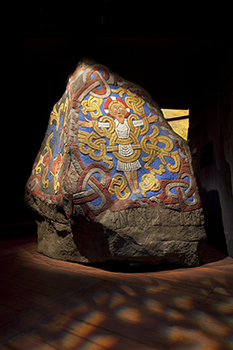
Harald’s Runes, The Figure of Christ (10th c.).
|
Jesus doesn’t say to the disciples: go forth and create shelters and food pantries and hospitals (although no doubt Jesus’ followers from the beginning until now have done just that, and there are other passages we could point to for license). He says, “Go forth and be yourself without a home. Be yourself hungry. Be yourself at the mercy of hospitality—good or bad.”
This is a much more difficult proposition. People who actually follow these instructions, people perhaps like Alpine or Solomon or Martin, we tend to judge and dismiss. We ourselves have something to give. We keep our egos firmly in place as we decide how to steward our resources, and how to dispense them with good sense. In this way, this passage suggests, we are not like Jesus’ disciples. It’s a bit of a shocking revelation to recognize that the fundamental identity of the follower of Jesus is not “helper” but helped. Not welcomer, but welcomed. Stranger, not host. Not savior, but saved. If we heal, it is only because we have been healed.
While I don’t know how to follow these instructions, I do see the Incarnation in them. We are to become what we seek to aid. God in Christ showed us how this is done. Jesus’ way is not to help others from a position of distance, superiority, and do-gooder-ism. Jesus’ way is to become poor instead. Expensive karma indeed.
Weekly Prayer
Anonymous
I saw a stranger yestereen;
I put food in the eating place,
Drink in the drinking place,
Music in the listening place;
And in the sacred names of the Triune
He blessed me and my house
My cattle and my dear ones.
And the lark said in her song:
Often, often, often,
Goes the Christ in the stranger’s guise.
Often, often, often,
Goes the Christ in the stranger’s guise.Translated from the Gaelic.
Amy Frykholm: amy@journeywithjesus.net
Image credits: (1) Newgrounds.com; (2) GraceIsEverywhere.net; and (3) Artchive.