From Our Archives
For an earlier essay on this week's RCL texts, see Dan Clendenin, Abraham’s Journey (2023).
This Week's Essay
By Amy Frykholm, who writes the lectionary essay every week for JWJ.
Matthew 9:9: “As Jesus was walking along, he saw a man called Matthew sitting at the tax-collection station, and he said to him, ‘Follow me.’ And he got up and followed him.”
For Sunday June 7, 2026
Lectionary Readings (Revised Common Lectionary, Year A)
Psalm 33:1–12 or 50:7–15
Romans 4:13–25
Matthew 9:9–13, 18–26
In Matthew 9:9, one verse tells an entire story. The call of Matthew is rendered in 30 English words in the version above. In Greek, it’s almost ten words shorter. But even so, it is a great story that, like a haiku poem, can only be grasped through deep attention. At each stage, a critical inflection point appears that must be felt to be understood. Jesus sees Matthew. Jesus encounters Matthew. Jesus speaks to Matthew, and Matthew responds.
In theologian Beverly Lanzetta’s book The Monk Within there is a paragraph that illuminates this story for me. In this book, Lanzetta is trying to lay out a road map for a new way of being a “monk” in the world. Her theory is that many of us are looking for new pathways. We’re frustrated by the kinds of spiritual experiences and spiritual certainties that are available to us. We hear the overused language of the church and we inwardly sigh with longing. But we also hear the degraded language of commercial culture and its cheap promises, and we know we don’t want that either. We want something different. We feel something different is possible, even demanded, but we don’t know how to name or embody these new possibilities.
She calls this impulse — one that she believes is shared by many — an impulse to “monasticism” because it evokes the ancient archetype of the monk who empties out old identities for the sake of allowing God to plant something new. She believes that this new path does not cling to old labels, so it doesn’t matter terribly much if we call it “Christian” or “Hindu” or “Jewish,” although we need those traditions to access the depth of experience and encounter we are looking for. We certainly don’t need to reject those labels so much as pay close attention to what they allow and what they foreclose.
She writes, “Monasticism is nothing more than a deconstruction project of continually stripping away unhealthy, false, or degraded identities to encounter the source of life’s fullness.”
So here is the call of Matthew. He is sitting, literally, at the table of his unhealthy and degraded identity as tax collector. Toward him walks the “source of life’s fullness.” The English writer, Jeannette Winterson, says that many great stories begin this way. Once upon a time, there was a person in circumstances that weren’t all that they hoped for. And then there was an encounter. In a moment, the bare facts of what is changed to what if, the expansion of possibility.
 |
|
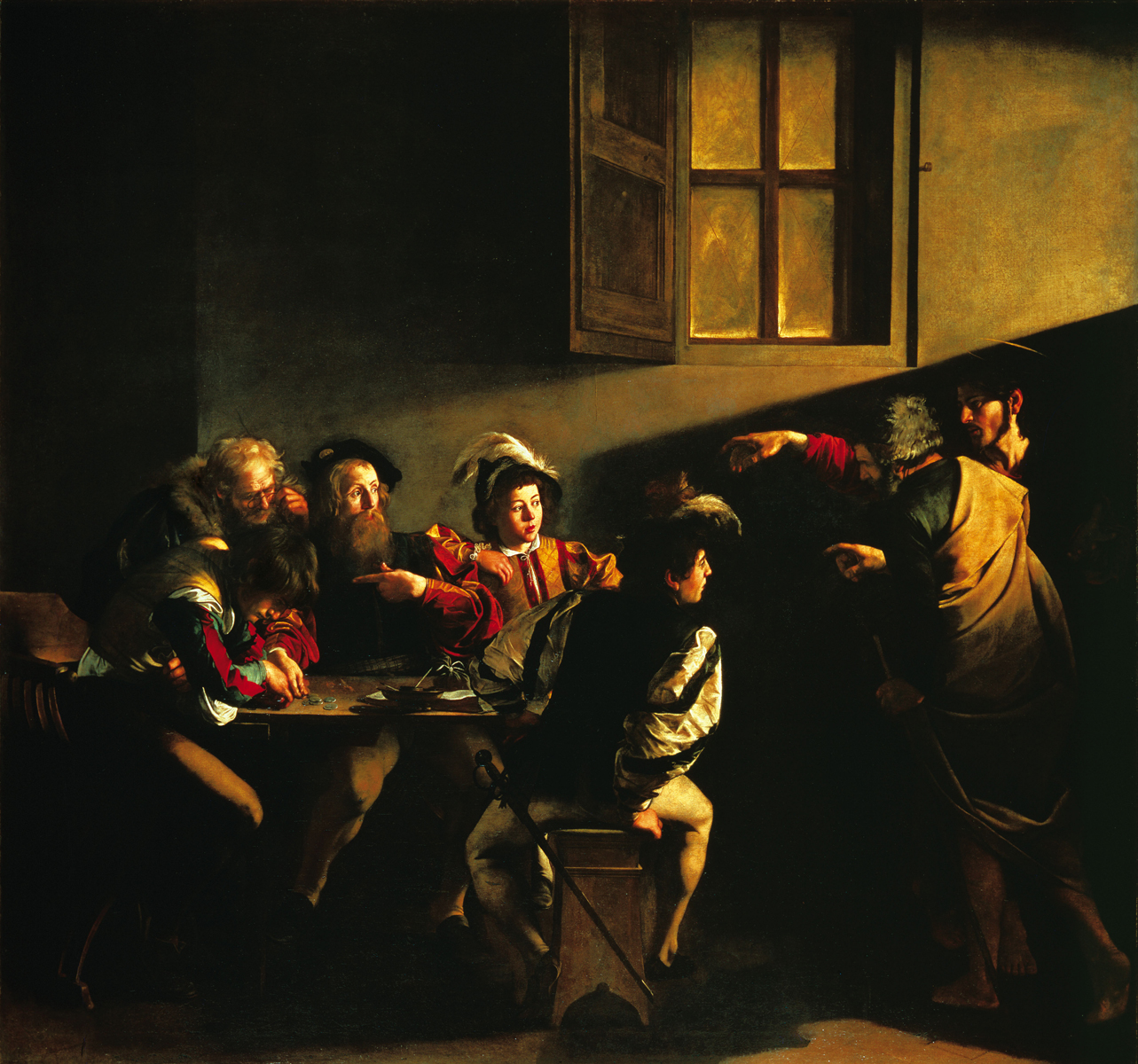
Caravaggio, The Calling of Saint Matthew (1600).
|
Jesus sees Matthew. He doesn’t see Matthew, the tax collector. He sees a full human being. He sees a soul who is “sick” (Matthew 9:12), but also one who is more than he appears. Where do our degraded identities come from? They might come from the accumulation of money or wealth or power, but they might also come from ordinary aspects of living, like duty or accident or the simple human needs for security or esteem. In contemplative Thomas Keating’s lectures The Spiritual Journey, he identifies how each of us comes into adulthood with a false self that has to be dismantled over time and even the noblest identities can degrade. But it isn’t this false self that Jesus sees. In Martin Buber’s language, Jesus sees “Thou” in Matthew — a being imprinted with God’s own image.
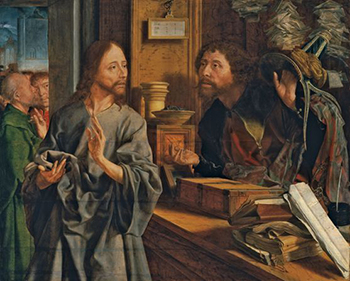
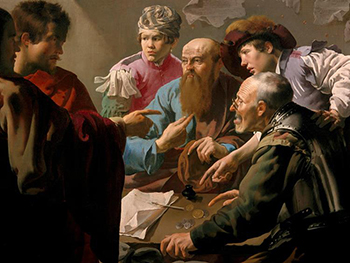
Thus Jesus and Matthew have an actual encounter. Clearly, as they truly see one another, something changes. Buber writes, “When two people relate to each other authentically and humanly, God is the electricity that surges between them.” While the text is entirely reticent about what happens when Matthew sees Jesus, we can imagine it. Painters like Caravaggio and Marinus Van Reymerswaele have tried to capture this moment in their paintings. Only if this surge of electricity takes place can we understand what happens next.
Jesus speaks to Matthew. “Follow me.” This interaction is the opposite of the transactional encounters that have dominated Matthew’s life. Jesus isn’t making a promise that if Matthew will only do certain things on Jesus’ behalf, he will justify him in front of the community. He doesn’t make any promises at all. In the First Nations Version of the New Testament, the translators render the call as, “Come and walk the road with me.” That choice illuminates what “follow” might mean. It’s an invitation to a journey, a path. Throughout the tradition, we’ve often seen these words as command and obedience. But then it’s easy to forget the flow of love present in this call.
 |
|
Marinus Van Reymerswaele, The Calling of Saint Matthew (c.1530).
|
This is the challenge that Matthew takes up when he responds, not with words, but with actions. He stands up, leaves behind the tax-collector’s table, and in consenting to follow, he becomes a new monk. The way that he is now following has all kinds of destinations of which he cannot be aware at the time — destinations both interior and exterior. Lanzetta writes that when we become a “new monk,” we “abandon the known for the unknown. Not relying on historical patterns and consensual agreements about how one should practice and live — without rejecting the authentic value and meaning in the world’s religions — the new monk is challenged to explore the wild regions, and to find the courage to be an artist for the divine.”
We might see the rest of Matthew 9 as commentary on this profound and life-changing encounter. The first thing that happens is that the Pharisees challenge the other disciples on the inclusion of Matthew in their midst. “Why does your teacher eat with tax collectors and sinners?” (Matthew 9:11). It’s a personal attack. A sting. Matthew, having just given up his old identity, is reminded that, in the eyes of others, he is still that other person, that what is new inside him is not yet visible.
Jesus himself offers the answer. You don’t have to be perfect to walk this road. In fact, it might work out better if you’re not. The vulnerability of Matthew’s fragile new identity, his emerging self, is the gift that he is bringing with him. “Those who are well have no need of a physician, but those who are sick,” Jesus says (Matthew 9:12). Through Matthew’s eyes and Matthew’s experience, we might be able to follow Jesus’ command, “Go and learn what this means, ‘I desire mercy, not sacrifice’” (Matthew 9:13).
Yesterday I received a call from a friend who is newly out of rehab. He’s in a sober living facility, being treated for PTSD and bipolar disorder, desperately trying to reunite with his wife. He has started a new job, but doesn’t know where the gas money to get to work is going to come from. He is in a fragile new way of being. He has a record of failures behind him, and what’s in front of him seems impossible.
 |
|
Hendrick Terbrugghen, The Calling of Saint Matthew (17th c.).
|
As I contemplate Matthew’s vulnerability, and hear the rumbling of the Pharisee inside of me, I hear this passage asking me to see old stories with the new monk’s eyes. The old me would take pity on my friend and give him gas money. That would reactivate an old pattern between us. I have a long-standing, much-degraded identity as helper. He as needy victim. I know that if I reactivate this pattern, I will also hold on to resentment and skepticism about his ability to walk this new path. And even though he might receive the help he wants in the moment, he also will walk away with the self-loathing that has kept him bound in addiction.
What would it look like for something more creative to happen? How could we come to this encounter as incomplete and vulnerable human beings and seek a genuine way forward? In truth, I don’t know. I hung up the phone feeling my heart heavy with all that seems impossible.
As we continue to read Matthew 9, however, the story becomes about remarkable and unexpected healings. Each of them have all the same elements as Matthew’s own encounter. The woman whose bleeding has isolated her reaches out. Jesus sees her, encounters her, speaks to her, and healing happens. A powerful man kneels before Jesus and asks for life instead of death for his daughter. Again Jesus sees, encounters, speaks, and healing takes place. Like Matthew, we are invited into the wild regions, a place where we can explore — with courage and without assumptions about how this is supposed to go — what healing might mean in our own contexts.
Weekly Prayer
William Stafford (1914-1993)
It could happen any time, tornado,
earthquake, Armageddon. It could happen.
Or sunshine, love, salvation.It could, you know. That’s why we wake
and look out — no guarantees
in this life.But some bonuses, like morning,
like right now, like noon,
like evening.William Stafford (1914–1993) was a prolific and celebrated American poet who wrote in a simple and unadorned style. James Finn Cotter wrote that Stafford's poems “reach out to the reader with a hand of trust and tenderness, time and again, in images that make small gestures large-hearted and full of importance.” This poem is from his collection The Way It Is (Graywolf, 1998).
Amy Frykholm: amy@journeywithjesus.net
Image credits: (1) SUNY Oneonta; (2) The Visual Commentary on Scripture; and (3) WikiArt.