From Our Archives
For earlier essays on this week's RCL texts, see Dan Clendenin, What I Do is Me (2023); Debie Thomas, The Undivided Trinity (2020), and The Best of All Beginnings (2014); and Dan Clendenin, Original Goodness: A Prayer from Outer Space (2011).
This Week's Essay
By Amy Frykholm, who writes the lectionary essay every week for JWJ.
Luke 1:45: “Blessed is she who believed that there would be a fulfillment of what was spoken to her by the Lord."
For Sunday May 31, 2026
Lectionary Readings (Revised Common Lectionary, Year A)
Genesis 1:1–2:4
Psalm 8
2 Corinthians 13:11–13
Matthew 28:16–20
OR
1 Samuel 2:1–10
Psalm 113
Romans 12:9–16b
Luke 1:39–57
In 2017, the new Hildegard of Bingen pilgrimage route opened. It leads through Germany from Idar-Oberstein to Bingen on the Rhine, tracing a route through the country that gave birth to and nurtured Hildegard of Bingen (1098–1179), the twelfth century theologian, poet, artist, doctor of the church, naturalist, medical practitioner, composer, and visionary.
The Pilgrimage Route was conceived by theologian and artist Annette Esser, who founded the Scivias Institute for Art and Spirituality and who envisioned the route after completing a pilgrimage on the Camino de Santiago in Spain.
Hildegard of Bingen was one of the most central intellectual figures of the twelfth century. Named a doctor of the church, she founded and led communities of women in the Rhineland. She authored extensive volumes of visionary theology. She composed the largest body of liturgical music that can be ascribed to a single author before the twelfth century. She also wrote works of physical science and medicine, preached to and corresponded with people from all ranks of society, and created a number of visual images based on her visions.
While Hildegard is an enormously complicated figure, the Hildegard Way makes experiential one of Hildegard’s central ideas: viriditas. Viriditas is the greening of God. For Hildegard, greening was no sentimental observation about spring. It was the divine force of life flowing through all things. In her poem O noblissima viriditas, Hildegard connects the greening of the earth with the force of divine mystery — the essence of life and the divine essence in one holistic vision.
O most noble greenness,
You are rooted in the sun,
And in bright serenity you shine in a wheel
That no earthly excellence comprehends,
You are surrounded by embraces of divine mysteries
You redden like the dawn
And you burn like the flame of the sun.
This greening doesn’t just tell us about God; it is God. Viriditas joins two other names for God that are central to the thought of Hildegard: caritas (divine love) and sapientia (divine wisdom). Together these three are responsible for all that exists, for all physical and spiritual healing, and for all the powers of both heaven and earth.
 |
|
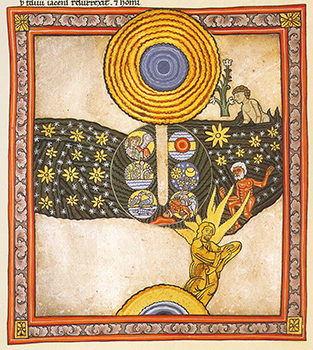
Hildegard of Bingen, Six Days of Creation (1152).
|
Extending far beyond the greening of the earth (which Hildegard observed as central to our spiritual and physical well-being), viriditas is something that happens within each of us. Hildegard regarded Eden as a place and a process where scholar Liz McAvoy describes “abundance is the result of the action and intra-action” of God with us.
By viriditas we are awakened to divine life and divine wisdom. In one of Hildegard’s visions, God says, "I, the fiery life of divine essence, am aflame beyond the beauty of the meadows. I gleam in the waters. I burn in the sun, moon, and stars. With every breeze, as with invisible life that contains everything, I awaken everything to life.”
This week’s lectionary texts offer us two seemingly separate sets of readings. Either we can meditate on The Visitation of Mary with Elizabeth (the feast day of the Visitation is May 31), or we can follow the traditional route to Trinity Sunday, meditating on Creation and the Great Commission. But as I sat with these passages, I began to see them, through the holistic eyes of Hildegard of Bingen, as both expressions of viriditas.
 |
|
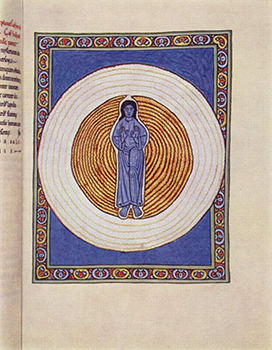
Hildegard of Bingen, The True Trinity in True Unity (c.1165).
|
In the story of the meeting of Mary and Elizabeth, we observe the encounter of two women whose lives have been upended by the new life that is within them. Both of these women have been overtaken by the caritas and sapientia of God and are now being awakened with unexpected force. Both of them sing songs of that awakening. “The child in my womb leaped for joy,” Elizabeth sings (Luke 1:44). “My spirit rejoices,” Mary answers (Luke 1:47).
Mary is an important figure for Hildegard. She is almost always depicted as shining with radiant light. Hildegard saw her as a model of viriditas within us — how through openness to divinity we can begin to cooperate with God in the healing and redemption of all of the whole earth. In Luke 1, she bursts into song. For Hildegard, song is “an essential element of both the original, unfilled creation and its redemption through Christ,” writes Nathaniel Campbell. Mary’s singing is a key sign for us of her awakening. And the fact that her song, following the song of Hannah, is about the overcoming of oppression, it shows us that when divine wisdom is awakened in us, we will always awake to a recognition of the brokenness and injustice around us.
Even more than the mother of the Divine Word, Hildegard saw Mary as “suffused with salvation history” (Campbell). She believed that God had always known, from the beginnings of creation, that Christ would become incarnate in human form, and therefore, God had also always known that this form would be Mary. The gleaming light of Mary is the gleaming light of dawn.
That is also the light suffusing the story of creation in Genesis 1. “Let there be light,” God says, “And there was light” (Genesis 1:3). This light is inseparable from God’s own greening lights, and it is the very same light that shines through Mary and through the Trinity. In the second vision of the second book of Hildegard’s Scivias, the Trinity is seen as “one light in one power of potential.” The light that comes through the sun is the one light of the Trinity, and that light sets all of life in motion.
To the Trinity be praise!
It is sound and life
and creator of all beings in their life.
It is the praise of the angelic host,
and the wondrous splendor of mysteries
unknown to humankind:
it is the life in all.
All of this is plenty abstract, but Hildegard is best understood through her deep connection with the natural world and her sense of its embodiment of divine power. Trees, plants, rocks, metals, birds, reptiles, and animals all have healing properties and are expressions of divine caritas, sapientia, and viriditas.
 |
|
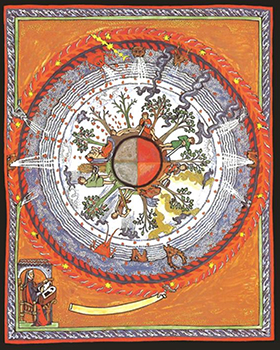
Hildegard of Bingen, The Cycle of the Seasons (12th c.)
|
We are all, Hildegard teaches, carriers of the divine light. We have interior gardens in which we cultivate these qualities of love, wisdom, and greening inside ourselves. And as love and wisdom flow through us, we participate in the greening of the world. We are, she writes, “so entangled with the strengths of the rest of creation that we can never be separated from them.”
If we follow Hildegard, we come to see ourselves as connected to the divine nature, with an essential responsibility for the greening of the earth and for the greening of ourselves—two things that are “so entangled” that “we can never be separated from them.” We come to understand ourselves as awakening to what Hildegard called the “original wisdom” of creation and the profound and ongoing work of viriditas.
Resources for further reading:
Nathaniel M. Campbell, “‘O Jewel Resplendent’: The Virgin Mary and Her Analogues in Hildegard of Bingen’s Scivias.” Religions 2023, 14(3), 342.
Annette Esser, The Hildegard of Bingen Pilgrimage Book (Collegeville, Minnesota: The Liturgical Press, 2022).
Liz Herbert McAvoy, “Tears, Mediation, and Literary Entanglement: The Writings of Medieval Visionary Women,” in Women and Medieval Literary Culture From the Early Middle Ages to the Fifteenth Century, ed. Corinne Saunders and Diane Watt (Cambridge: Cambridge University Press, 2023).
Weekly Prayer
Hildegard of Bingen (1098–1179)
O most honored Greening Force,
You who roots in the sun;
You who lights up, in shining serenity, within a wheel
that earthly excellence fails to comprehend.You are enfolded
in the weaving of the divine mysteries.You redden like the dawn
and you burn: flame of the sun.Hildegard of Bingen (1098–1179) lived a life that was remarkably long and incredibly productive. Translator Carmen Butcher has described Hildegard as an "Über-multitasking Frau" and authentic "polymath." The Benedictine abbess founded two convents, conducted four preaching tours, penned at least 400 letters, wrote music and a morality play, supervised illuminated manuscripts, cared for her fellow sisters, and wrote three major theological tomes based upon her famous visions. This poem is from Causae et Curae.
Amy Frykholm: amy@journeywithjesus.net
Image credits: (1) Wikimedia.org; (2) Artchive; and (3) Artchive.