
Book Notes
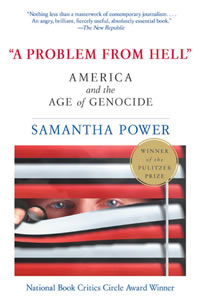 Samantha Power, A
Problem From Hell; America and the Age of Genocide (New York:
Harper Collins, 2002)
Samantha Power, A
Problem From Hell; America and the Age of Genocide (New York:
Harper Collins, 2002)
As I write the world has just commemorated the tenth anniversary of the Rwandan genocide, including the obligatory refrain of “never again.” But in the Darfur region of western Sudan about a million people have been displaced and poured into eastern Chad, fleeing systematic rape, pillage and burning of villages by government-backed Janjaweed militias whose goal is to purge the country of their darker skinned fellow Muslims.
What has the world done? Pretty much nothing. Once you read Samantha Power’s book you will not be surprised. Power’s long treatise won a Pulitzer and virtually unanimous praise as a brilliant volume on a disturbingly familiar problem in our world.
Power traces the history of the term “genocide,” a neo-logism created by the eccentric and brilliant Raphael Lemkin, a Polish Jew who almost single-handedly thrust the issue of genocide onto the world stage. On October 16, 1950, after seventeen years of Lemkin’s labor, the Convention on the Prevention and Punishment of the Crime of Genocide was finally ratified by the United Nations. She also traces the history of the world’s major genocides—Armenia, Jews, Cambodia, Iraqi Kurds, Bosnia, Rwanda, Srebrenica, and Kosovo.
It took the United States thirty-eight years to sign the convention; ninety-seven nations had ratified the convention before us (p. 165). This is consistent with our overall history and response to genocide, Power concludes. Across time, place, ideology and geopolitics, the US has remained consistently passive in the face of genocide. Despite graphic images and evidence of genocide, we lack the moral imagination to believe the unbelievable. Politicians calculate that the indifference of the public means their own indifference will cost nothing, whereas involvement in genocides can be very costly. In short, we are a nation of predictable “bystanders” when it comes to genocide.

