
Book Notes
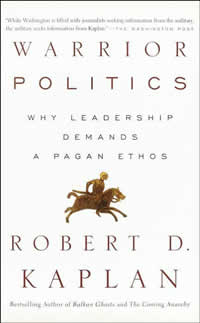 Robert Kaplan, Warrior
Politics; Why Leadership Demands a Pagan Ethos (New York: Random,
2002)
Robert Kaplan, Warrior
Politics; Why Leadership Demands a Pagan Ethos (New York: Random,
2002)
Watching the news each night about the Iraq war, replete with powerful images of prison tortures, destroyed cities, fleeing civilians, crowded hospitals, suicide bombers and the like, makes Robert Kaplan’s book of a few years ago sound prescient: “The post-Industrial Revolution empowers anyone with a cellular phone and a bag of explosives. America’s military superiority guarantees that such new adversaries will not fight according to our notions of fairness: they will come at us by surprise, asymmetrically, at our weakest points, as they often have in the past. Asymmetry gives terrorists and cybercriminals their strength, since such adversaries operate beyond accepted international norms and value systems on a plane where atrocity is a legitimate form of war” (p. 9).
It used to be that we feared states that sponsored terrorism, but now we must fear terrorists that sponsor states. Kaplan takes a very grim view of human nature and argues that in today’s world statecraft must have the moral imagination to think the unthinkable. The pagan ethos he commends, then, is rooted in a “constructive pessimism” or pragmatic realpolitik that forces us to think “tragically.” Hobbes and Malthus, he suggests, are sure guides; we should not be surprised by anarchy, terror, barbarism, and irrationality. American exceptionalism---the naïve notion that we are different and will escape tragic history—is foolish hubris (witness American murder, rape and torture of Iraqi prisoners). In Kaplan’s view, the goal of statecraft is to use coercive power to make the best of bad situations and to bring order out of chaos.
I find Kaplan’s realism compelling, but chilling to my Christian sensitivities. Modern statecraft must always separate personal virtue and public policy. The warrior politician, says Kaplan, must like Machiavelli know how to do bad in order to accomplish good, promote the necessary and not the nice, sanction deceit to avoid war, refuse intervention when no national interest is at stake, or kill many people in order to avoid killing even more people. The Christian, it would seem, has two choices: withdraw from this unsavory realm, or enter the fray at the risk of losing your soul.

