
Book Notes
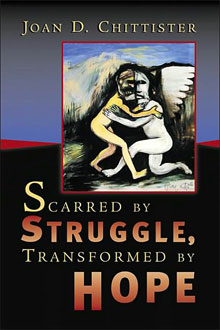 Joan Chittister, Scarred
By Struggle, Transformed by Hope (Grand Rapids: Eerdmans, 2003)
Joan Chittister, Scarred
By Struggle, Transformed by Hope (Grand Rapids: Eerdmans, 2003)
The myths of Superman and Superwoman are alive and well in our culture, but also in our churches. As I sit in the pew week after week, I am told that the Christian life is one of miracles, growth from strength to strength, joy and celebration. “It’s just that simple,” I heard from the pulpit recently. But when I took inventory of my own life, nothing felt simple.
Like our culture at large, believers celebrate wealth, power, strength, bravado, and confidence. We abhor weakness, failure, struggle and doubt. Vulnerability, fear, discouragement and depression are construed as signs of immaturity or lackluster faith. In real life, for most people, this naïve optimism and rhetoric of idealism is a recipe for deep disappointment, for sooner or later reality catches up with most of us.
In contrast, the Benedictine writer Joan Chittister offers what she describes as a “spirituality of struggle” which takes as its paradigm the narrative of Jacob’s struggle with the angelic visitor (Genesis 32:22-32). Jacob had swindled his brother Esau and then deceived his blind father in order to steal the family blessing. He fled in fear. At the river Jabbok he then wrestled all night with the angelic visitor who somehow was God himself. The result? God blessed this cheater and liar, but the blessing came with a crippling touch to the hip. He limped the rest of his life.
Frederick Buechner described this same text of Scripture as the “magnificent defeat of the human soul at the hands of God.” Chittister calls it a “spirituality of struggle”. The apostle Paul spoke of being “harassed at every turn---conflicts without, fears within” (2 Corinthians 7:5, NIV). In the Jacob narrative Chittister finds eight elements of the struggle---change, isolation, darkness, fear, powerlessness, vulnerability, exhaustion, and scarring. But these are not the end of the story, for in response to each struggle there is a divine gift---conversion, independence, faith, courage, surrender, limitations, endurance, and transformation.
“Jacob does what all of us must do if, in the end, we, too, are to become true. He confronts in himself the things that are wounding him, admits his limitations, accepts his situation, rejoins the world, and moves on” (p. 87). This is not an easy path, but it is one with Biblical warrant: “When I am weak, then I am strong” (2 Corinthians 12:10).

